
Kumar Sporting Club: The Pioneering Football Club of Sikkim


Though Cricket is looked open as a gentlemen’s game and is being adored by almost all of the Indians, football has its own tang and recognition among the people of the Himalayan States. The Himalayan states, particularly the North Eastern States of India have been able to provide the greatest football players for the Country. Among them Sikkim has always enjoyed a top position. There is no doubt to ascertain that football flourished into Sikkim with its contact with the British. Possibly, the Colonial Sahibs used to play football during leisure from where the Sikkimese privileged also imitated. Thus, football attained its popularity among the Sikkimese masses which has now become an inseparable part of the Sikkimese society.  
We do not have much information about the prevalence of Football Clubs in the initial decades of the 20th Century. Much later in the 40’s, few football enthusiasts from Gangtok founded its first ever football club. This very football club was thence known as Kumar Sporting Club. It was established in the name of Crown Prince Late Paljor Namgyal, who was in the Indian air force with the British and died in a plane crash in December 1941 during Second World War in Burma. It has to be mentioned here that the Crown Prince was affectionately nicknamed as Kumar Sahib, a shaded adaptation of the word Maharajkumar Sahib. Hence, the first football club of Sikkim got its name as Kumar Sporting Club. The Kumar Sporting Club won the first cup outside Sikkim in 1948. The Paljor Stadium of Gangtok is named after the late Crown Prince Paljor Namgyal.
Football is always a favorite to the Sikkimese- Prince Tenzing Namgyal 
The Kumar Sporting Club was followed by Gangtok Football and Sporting Association. After 1973, the Gangtok Football and Sporting Association was given affiliation by the All India Football Federation (AIFF). In a national tournament the Gangtok Football and Sporting Association lost its match against Goa by 10 goals which became the crossroads in the history of football in Sikkim. After this humiliating defeat, the Gangtok Football and Sporting Association was renamed as Sikkim Football Association (SFA) in 1976. With the foundation of Sikkim Football Association, Sikkim gave some of its best players to the country like Samdrup Norden, Pem Dorjee (the first Sikkimese to lead the Indian Football team as a Captain) Kul Bahadur Chettri and many other youngsters like Mr Ong Tshering Lepcha (Former Captain India Under 21 Team) Nirmal Chettri (East Bengal and Defender Team India) Sanju Pradhan (East Bengal Midfielder) and many others who have played professionally for various Football Clubs all over the Country. Nevertheless, the biggest contributions to Indian Football from Sikkim have been the annual Governor’s Gold Cup, annual Chief Minister’s Gold Cup and Padmashree Bhaichung Bhutia (former Captain of Indian Football Team) now the founder and owner of United Sikkim Football Club.
The journey of Sikkim’s Football enthusiasm which had its start with the small Kumar Sporting Club has now become an immense SFA with its pride Pem Dorji, Samdrup Norden, Bhaichung Bhutia, Kul Bahadur Chettri and many others who are struggling to get their place in the Indian Football Team. The credit of producing these football heroes of Sikkim always goes to the Kumar Sporting Club, the pioneering Football club of Sikkim.


Sikkim Almanac: A Monarchical Souvenir to the State of Sikkim


Sikkim Almanac
Every Sikkimese has seen Sikkim Almanac hanging on the walls of every Official building or in every house to get an idea about the official government sanctioned holidays for a particular year. But, we have never paid any attention to understand its link with the past of Sikkim. The Sikkim Almanac nowadays is merely serving as an everyday planner of the Sikkimese people. But, distant from being the official holiday marker the Sikkim Almanac has its profound bond with the history of the erstwhile Himalayan Kingdom of Sikkim.
The Royal Government of Sikkim began to issue its Almanac, which lists the official government sanctioned holidays for each year, in the mid 50’s of the last century. The noble task was undertaken during the glorious reign of Maharaja Sir Tashi Namgyal. The sole purpose of issuing such Government Calendar was to inform the subjects of the Maharaja about the Government sanctioned holidays in the kingdom of Sikkim, so that they could avoid themselves from reaching the Capital during holidays for their Official works. The Government sanctioned holidays in the calendar were highlighted with red colour which was easier for every individual to get an idea of the existing holiday in a particular month. The very same layout of Almanac is still prevalent in the Sikkim Almanac issued by the Government of Sikkim.
The Sikkim Almanac has some distinctive features as well. In conjunction with the dates of Gregorian calendar in English are the dates of Tibetan Lunar Calendar in Tibetan scripts. Presently, the heading carries emblem of Sikkim Government but, during independent Sikkim it used to have a portrait of the reigning king of the Kingdom. The fifties (1950’s) version of the Sikkim Almanac carried pictures of Maharaja Sir Tashi Namgyal in full Royal ceremonial dress, while the pictures of Chogyal Palden Thondup Namgyal were more casuals. The placing of the King’s pictures on Sikkim Almanac was stopped after Sikkim’s integration with the Indian Union. Apart from English and Tibetan languages the title of the Almanac is also written in other Sikkimese languages like Lepcha, Nepali and Limbu which is in vogue since its first issue.
Either side of the Almanac is bordered by the Eight Lucky Signs known as Tashi Tagey (Tak Gye) in Tibetan. These auspicious signs are symbolic with the life and teachings of the enlightened Tathagatha. After Sikkim’s integration with India, the Sikkim Almanac is printed and distributed by Home Department, Government of Sikkim every year.

A Handwritten Sikkim Herald- The oldest Surviving Newspaper of Sikkim


The publication of Sikkim Herald was started in 1956 during the reign of Maharaja Sir Tashi Namgyal to inform his subjects about the developments brought about by the Government. The initial format of Sikkim Herald was a magazine and it used to get publish every months. Prior to 1962, the Sikkim Herald Magazine was brought out in English only and later sometime in 1962, editions were brought out in Bhutia and Nepali languages as well.
The Handwritten Sikkim Herald in Nepali preserved at Ramgauri Sangrahalaya 
The picture with today’s post is also of this oldest newspaper of Sikkim in Nepali Language. The remarkable attribute of this publication of 1967 (6th Year Issue 21) is that it is a handwritten newspaper which was published on Thursday 16th February 1967. It is possibly a first of its kind in the history of journalism in Sikkim. The Top Headline of this issue deals with the suspension of the Sikkim Executive Council in the said year. It states “As per the Government Report published by the Chief Secretary Government of Sikkim Mr. T.S Gyaltsen, the Maharaja has unleashed the Councillors from their posts on 15th of February 1967 as they were busy in campaigning for the forthcoming election. Henceforth, the subjects are informed that their applications related to various concerns are to be sent to the concerned Head of the Departments for necessary action”.
The Second Headline of the Newspaper deals with the resistance techniques to be adopted to protect an individual from “Mai” influenza. The Herald has informed about the suspension of classes from all the schools for 15 days surrounding Gangtok to prevent from its further transmission. Further, this handwritten issue of Sikkim Herald has also informed the public about the date and venue as well as necessary requirements to sit for the written examination of a stipend for the year 1966-67, granted to the Sikkimese Students by the Government of India.
The Last News is an obituary on the demise of Mukhtiyar Palden Dorjee. The Sikkim Herald is now a daily publication brought out by the Information and Public Relations Department (IPR), Government of Sikkim, containing news and information on the developments and the programmes of the Government as well as notices regarding tenders and other important government notifications. One can find Sikkim herald in all the major languages spoken in Sikkim like Bhutia, Lepcha, Nepali, English and Limboo.
The only piece of this Handwritten Sikkim Herald is preserved by Shree Ganesh Pradhan of Ramgauri Museum Rhenock East Sikkim. I am greatly indebted to him for sharing this priceless document with me.

Kagyad Chaam- A Symbol of Peace and Prosperity

The main Torma  
Monks performing with liturgical music
Kagyed Chaam is a Sikkimese Dance performed on the 28th and 29th day of the 10th Month of the Tibetan calendar which generally falls in the last week of December. The word Chaam in Tibetan corresponds to a dance performed by various artists. This dance is performed in Sikkim symbolizing the destruction of the evil forces and hoping for peace and prosperity to flourish in every Sikkimese home. The dancers of this enormously admired Chaam are always monks who are accomplished in liturgical music and chanting. The solemn nature of the dance is interspersed with comic relief provided by the jesters. Kagyed dances enact various themes from the Buddhist mythology and culminate with the burning of effigies made of flour, wood and paper. During monarchy, Sikkim used to celebrate this dance as a national event. One can notice the Kagyed Chaam celebration of monarchical Sikkim in the visuals of much awaited documentary of Satyajit Ray.
Monks performing Kagyad Chaam at Enchey Monastery Gangtok  
With full of religious fervour this year also Kagyed Chaam was performed in a majestic comportment at Enchey Monastery Gangtok. The pictures with this post are taken by Mr. Tashi Wangyal Denzongpa at Enchey Monastery. I am thankful to him for sharing these pictures. 

Feudal Judicial System of Sikkim- A Brief Review


Like any other feudalistic arrangements, the judicial system of Sikkim has a history of its own. The King though, enjoyed a highest position in the feudalistic set up, could not execute his judicial obligations properly as he was surrounded by the then “Elites”, the Kazis, who were the de-facto arbitrators of their Ellakas. They could tax, confiscate, mortgage and sometimes seized the lands of peasants into Home Farm, the Private land holdings of the Kazis.   In short, the Kazis were the fountainhead of justice in feudalistic Sikkim and it is because of such “Lawless Law” the ordinary peasants were compelled live a combatant’s life.
Sikkim’s contacts with the British Indian Government had even worsened the existing judicial system of Sikkim. Available testimonials highlight that in 1909, the Kazis, Thikadars and Lamas were invested with legal powers by a State Council Resolution. They could try Civil Suits up to the valuation of Rs. 500/-. The State Council Resolution of 1909 had thus given an overwhelming power to the state machinery (Kazis, Mandals, Mukhtiyars, Karbaris) to exploit the common people, especially the peasants in the name of legal action. It is to be mentioned here that the formation of “British Styled” State Council used to have the British Political Officer as its President. After the establishment of the said Council, the Sikkimese Kings were kept behind curtail and the British Political Officer began to take decisions, enact Laws and to rule the Kingdom with the assistance of pro-British Kazis like Phodang Lama, Khangsa Dewan and Shoe Dewan and so on. The Kings whosoever tried to oppose the new set up either were sent to prison (Maharaja Thotub Namgyal) or were given mysterious death (Maharaja Sridkyong Trulku). Before the establishment of High Court at Gangtok, administration of justice in Sikkim was being carried out by the Feudal Landlords (Adda Courts), Dzongpens (District Officers). Pipons (Headmen) and Mandals with the Chogyal at the top.  All the important judgments were given at the Adda Courts and at the Settlement Houses by the Feudal Officials and used to give inhuman punishments of Thinguro placed at the Kazi’s House. These Thinguros were made up of wooden planks, the culprit had to put his legs inside the hole of the Thinguro, after doing it, the mouth of the Thinguro was tighten by a rod or an iron, thus, leaving the culprit standing with utter pain. He could not sit as the wood was tightened on his knees, therefore he did not have other alternatives than to cry in the dark prison of the Kazi. Further, he was not given a single drop of water for three four days, after the Kazi got satisfied from the punishment, finally he was granted pardon.
In 1916, Appellate Courts by the designation of Chief Court was created with jurisdiction to try important original suits and also to hear appeals against the decisions of the Adda Courts. But, from the study it reveals that there were very few cases of appealing against the decision of the Adda Courts due to the threat of havoc from the Kazis and Mukhtiyars. This Court also exercised supervisory and appellate jurisdiction over the Adda Courts. The Chief Court was not the final Court. The appeal against the decision of the Chief Court would lie to the Supreme Court of His Highness, the Maharaja. The Court of the Maharaja was the final Court of appeal in the State. It has no original jurisdiction. A Board on the lines of the Judicial Committee of the Privy Council in England would hear the parties and scrutinize the evidence regarding merit of the case and then tender its opinion to the Maharaja. (From the compilation of Hon’ble Shree A.P Subba, Former Judge High Court of Sikkim)
 In 1949, the Adda Courts were abolished on the recommendation of the Judicial Proposal Committee. The State was divided into 4 (four) revenue Districts and Magistrates were appointed in District with original and appellate jurisdiction on the criminal and civil side. The Courts of the Assistant Magistrate and the Court of Tahsildars were created. In the lowest rung, a few Honorary Courts of Magistrates were created to dispose of petty criminal and civil cases. The Chief Magistrate had both original and appellate jurisdiction on civil and criminal sides. He had unlimited powers (From the compilation of Hon’ble Shree A.P Subba, Former Judge High Court of Sikkim). 
The independence of India breeds a new hope of liberty inside the minds of the peasants of Sikkim. They too began to organise themselves in a larger manner for their rights and liberties. Due to pressure made by Sikkim State Congress, all the forced labours were wiped out by the reformist Maharaja Sir Tashi Namgyal in 1948. Further, the overwhelming powers enjoyed by the Kazis and his Officials were also restrained, indicating a new aeon in the history of Judiciary of Sikkim. From the available records it appears that in 1953, a Judge of the High Court of Sikkim was appointed but in 1955, High Court of Judicature (Jurisdiction and Powers) Proclamation, 1955 was issued establishing a High Court in Sikkim. The High Court thus established was made the final Court in all judicial matters, civil or criminal, subject to the exercise of prerogative by the Maharaja to grant mercy, pardon, remission, commutation and reduction of sentence in case of conviction. The Maharaja had also retained his prerogative to set up a Special Tribunal for the review of any case, civil or criminal. 
After becoming the 22nd State of India under Clause (i) of Article 371F, the High Court functioning immediately prior to the date of merger became the High Court for the State of Sikkim under the Constitution like any other High Court in the country. Under Clause (i) of the same Article all Courts of Civil, Criminal and Revenue Jurisdiction, all Authorities and all Officers, Judicial, Executive and Ministerial throughout Sikkim were to continue to exercise their respective powers subject to the provisions of the Constitution and under Clause (k) all laws in force immediately before the appointed day in Sikkim were to continue to be in force until amended or repealed by a competent legislature or other competent authority. 

Sikkim Jewels: A Legacy of Royal Government of Sikkim Shuts Down


Pic: Sikkim Now

Sikkim Jewels Ltd. Was established in 1972 during the reign of its last Chogyal Palden Thondup Namgyal. The foremost intention of establishing such industry by the Royal Government of Sikkim was to cater to the demand of Watch Jewels and Cup Jewels. The Company had started with a very small capacity of producing 2.00 Lakhs of Cup Jewels and 1.50 Lakhs of Watch Jewels per month. It was established at Tadong Gangtok and is spread over 3.23 acres of land. Sikkim Jewels Ltd used to be the second oldest Company of the erstwhile Kingdom of Sikkim. The oldest of such Companies is Food Preservation Factory at Singtam established in 1956, during the reign of Maharaja Sir Tashi Namgyal, the reformist. The Company had strengthened its position in the market for Watch Jewels, Cup Jewels and Rotor Magnets. In all these products, it had obtained sizeable orders from all the leading manufacturers of India like Hindustan Machine Tools Ltd., Titan Industries Ltd., and Allwyn Watches Ltd., Jaipur Meters and Electricals Ltd., VXL India Ltd., and Andhra Pradesh Electricals and Equipment Corporation.
There was heavy recession in domestic market in all the three major items produced by Sikkim Jewels Ltd. Hence, the factory was running under its own capacity since 1997. Only in 2000-2001, the unit had been able to increase its production after receiving substantial orders from both domestic and international market. The unit produced a record of 30 Lakhs Watch Jewels in November 2000. Amid to its increase in production, the current world wide economic depression has compelled Sikkim Jewels Ltd. for an untimed demise.
The Daily Telegraph of March 11 2011 reports:
The Sikkim government has decided to wind up Sikkim Time Corporation, Sikkim Jewels Limited and Sikkim Precision Industries Ltd after attempts to revive the three loss-making public sector undertakings through private participation failed....... State commerce and industries secretary M.G. Kiran said the decision to shut down the three PSUs had been taken by the cabinet on March 2.

Kham Sum Ongdi the National Emblem of Monarchical Sikkim


Kham Sum Ongdi used to be the Royal as well as the National emblem of erstwhile Sikkim used by the ruling house of the Namgyals. It is not clear since when the emblem was used by the Sikkimese monarchs to sign the Royal Decrees and Proclamations. Possibly, it came into vogue after Sikkim’s contact with the British East India Company in the 30’s of 19th century. A shell, regarded as a holy article both by the Hindus and the Buddhists is at the top of the seal which is guarded by the two Gaduras that is considered as the vehicle used by Lord Vishnu, the protector of the extraterrestrial world by the Hindu and Buddhist mythology. The interesting feature of this Royal Emblem is that even after loosing its sovereignty, the State Government of Sikkim uses it as the Government insignia. The words Kham Sum Ongdi in Sikkimese Bhutia mean “Conqueror of the three realms”.

Lost Days of Sikkim Monarchs

Inside Father's Car- Prince Tenzing Namgyal and Prince Wangchuk Namgyal

Prince Tenzing Namgyal getting ready for a "Test Drive"?

Prince Tenzing Namgyal

Football is always a favorite sport in Sikkim- Prince Tenzing with his fellow players at the palace ground 
These pictures bear copyright of http://gxp1201.tibetcul.com (A website of People's Republic of China) I am greatly indebted to Tempa Transhimalayan Arts Taipei Taiwan for sharing link of these incredible pictures of erstwhile Himalayan Kingdom of Sikkim.  

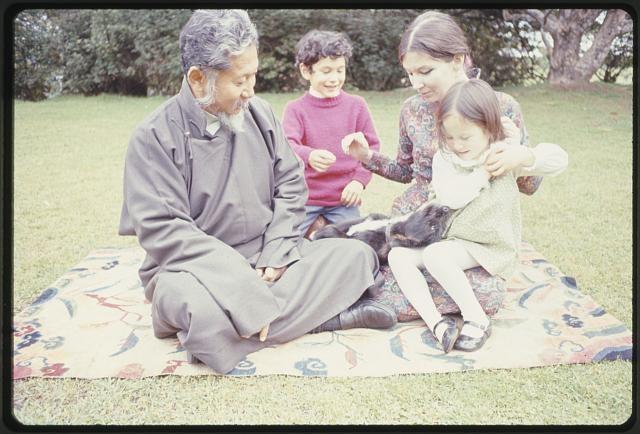
Incredible pictures of Hope Cooke Namgyal with Prince and Princess of Sikkim

Prince Palden Namgyal and Princess Hope Leezum of Sikkim 

Her Highness Hope Cooke Namgyal with Princess Hope Leezum


Princess Hope Leezum

Her Highness with the Prince

The Pride of being a mother- Her Highness with her children 
These pictures bear Copyright of http://gxp1201.tibetcul.com (A Website of People's Republic of China) I am greatly indebted to Tempa Trans-Himalayan Arts, Taipei Taiwan for sharing the link of these valueable photographs with me. 

Some Rare pictures of the Last Days of Sikkim Royals

A Royal Lady with Sikkim Guards

Chogyal Palden Thondup Namgyal & Hope Cooke Namgyal with princess Hope Leezum and Prince Palden

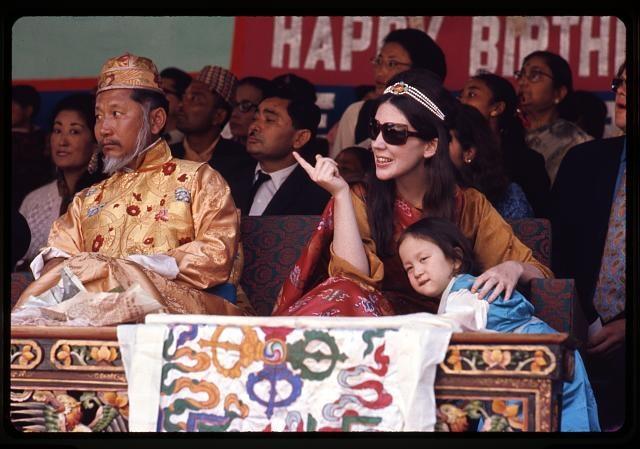
The Royal Couple at the King's Birthday

Gyalmo Hope Cooke Namgyal during her Reading Hours
The Chogyal being greeted by his subjects


Chogyal's beloved Hope-La
These pictures bear copyright of http://gxp1201.tibetcul.com (A website of People's Republic of China) I am greatly indebted to Tempa Transhimalayan Arts Taipei Taiwan for sharing the link of these valuable pictures with me.  

Some Rare Pictures of Her Highness Hope Cooke Namgyal- The Gyalmo of Sikkim


Her Highness at a Center of Technical Education  

Working on Buddhist Manuscript

Possibly at Namgyal Institute of Tibetology

Her Highness getting ready in National Costume 

Her Highness with Prince Palden

Her Highness attending a function

Her Highness at a  Hand loom center

Probably searching Sikkim's destiny in the Map of Asia

Her Highness in her reading room

In the palace   
These pictures bear copyright of http://gxp1201.tibetcul.com (A website of People's Republic of China) I am greatly indebted to Tempa Transhimalayan Art, Taipei, Taiwan for sharing the link of these incredible pictures with me.

Last Days of Sikkim Royals- The Chogyal and Gyalmo

The Chogyal and Gyalmo during a religious gathering at the Palace

Meeting commoners during Royal tours

The King with his beloved queen Hope-La

During Religious Celebration


During Rituals

On the palace lawn 

Chogyal and Gyalmo

The royal couple inside the palace
These pictures bear copyright of http://gxp1201.tibetcul.com  (A website of People's Republic of China)I am greatly indebted to Tempa Transhimalayan Art, Taipei, Taiwan for sharing the link of these incredible pictures with me. 

Old Pamphlet of Sikkim Congress (R)


Name of the Publisher on the back cover page 


Pic Voice of Sikkim 
Contents inside the Document 
The Cover of the Pamphlet 
This is a booklet circulated by Sikkim Congress (R) in the 80’s against the case filed by the State Government of Sikkim and Government of India against its President Shree Ram Chandra Poudyal.  This document contains 44 pages and is written in Nepali, the lingua-franca of Sikkim. It titles  R.C Poudyal viruddha Bharat Sarkar tatha Sikkim Sarkar- Sikkim Uccha Nyayalayama Hamro Muddha (The Indian and Sikkim Governments against R.C Poudyal- Our case at the Sikkim High Court). It deals with the protection and right implementation of Article 375 (f) of the Indian Constitution, which basically deals with the security of Old Sikkim Laws and Conventions. The booklet was published by Ram Lepcha, General Secretary of Sikkim Congress (R) and was printed at Vijay Printers, Tibet Road, Gangtok. The cost of this booklet was Rs 1.