Showing posts with label Sikkim Education. Show all posts

Government Senior Secondary School Ranipool- A Story of its Establishment


Ranipool School at Ghatttey Hill  in the 60's

Since my school days I was always curious to know about the founder of the school from where I got into the world of knowledge and acquaintance. It was indeed a slumbered historical sense that was at its initial stage which forced me to know much about the founder of my school. I also had a big question on my infant mind why my school was entitled as Ghattey School? Few people informed me that before the establishment of a school at the earlier site there used to be a Pani Ghatta (Grinding machine that runs with water power) and the place was thence known as Ghattey Dara (Ghattey Hill). Hence after the commencement of a Primary School at the Ghattey Hill the school got its name as Ghattey School. Few others informed me that the school was founded by a person from Namli called Brihaspati Parsai. This was the only knowledge that I had been able to acquire about Government Senior Secondary School Ranipool before I accomplished my Twelfth Standard.

Teachers' and Students' in the 60's
Late Brihaspati Parsai collecting funds for the School 
To acquire more knowledge about Government Sr. Sec. School Ranipool I decided to meet the descendents of the founder of my School during my fieldwork. I met Mr. N. B Parsai one of the sons of Late Brihaspati Parsai from whom I had been able to extract many unheard and unknown facts about the establishment of the said school. According to him the founder of Ghattey School Late Brihaspati Parsai had never seen any schools in his childhood. During the construction of NH 31A he worked there as a labour and later became an A Class contractor. In 1944 as a contractor he took up the task of “Cutting off Land” where he had to suffer a heavy loss. The Officer of Public Works Department Fakir Chand Jali (who was also the First Overseer and First Chief Engineer of Sikkim) told him that he incurred loss owing to his lack of knowledge in English language. That incident was a turning point for the foundation of Ranipool School. Immediately after this event Late Parsai with the help of a supervisor started a school in 1945 at Labours’ Quarter. Later Brihaspati Parsai asked a piece of land from one Langadey (Limp) Kazi for the construction of a school. The Kazi was kind enough to donate a piece of land to start a school at Ghattey Dara. Thus, the foundation of Ranipool School was laid with the efforts of an illiterate at the Ghattey Hill.
Mr. N. B Parsai has given me additional information about the first teachers of this school. According to him, Late Jayadev Sharma of Rumtek and Damber Gurung were the first teachers to serve Ranipool School. He further updated me that the school was once visited by Maharajkumar Sahib Palden Thondup Namgyal. “It was in the summer of 1946 a Wyllian Jeep came to the school compound and a gentleman in a royal costume came out of it. We did not pay much heed to know about him as we were busy in playing. The gentleman looked us for a while and moved into the office. Within a minute Jaydev Sir came out and introduced him as Maharajkumar Sahib. Maharajkumar Sahib Palden Thondup Namgyal encouraged our teachers to impart good education to the children. It was indeed a great moment for all the students to get a glimpse of the Maharajkumar Sahib at our School Compound”.
Welcoming the dignitaries during an event in the 60's 
Late Brihaspati Parsai had a deep lament that he could not study therefore; he had a determined thought that the children of peasants would be suppressed until they do not get education. Hence, with the intention of educating everybody he raised donation to run the Ghattey Hillock School. For several years he himself paid the salary for the teachers and other staff. Later the Royal Palace turned the Ghattey Hill School into a government aided institution and began to provide a grant of Rs. 30/- per month. But, the sanctioned amount from the Royal Sikkim Government was not enough to run a full fledged school. Therefore, late Brihaspati Parsai moved from door to door asking for donation for the salary of the teachers.All the students of today’s Brihaspati Parsai Memorial Senior Secondary School are greatly indebted to its illiterate founder who had an extreme faith in educating the masses for a colossal change.

Students and Teachers with new furniture on the day of becoming a Govt. aided school
Recent picture of Brihaspati Parsai Memorial School 
Respecting the contributions of Late Brihaspati Parsai to impart modern education among the peasantry of Sikkim the Sikkim Government has changed the name of Government Sr. Secondary School Ranipool as Brihaspati Parsai Memorial Senior Secondary School. For the encouragement among the students the Parsai family of Namli is providing a scholarship of Rs. 10,000/- each every year for the best two students of the school founded by their grandpa late Brihaspati Parsai.


Letter of Namchi Kazi to Sikkim Durbar 1937


Education has always played a vital role for the political development of a country. But, in the erstwhile Sikkim it was a privilege enjoyed only by the super class. People belonging to the grass root level did not have any opportunity to attend a school. In every society, people began to dream for a better life only after getting closer to education.  Hence, it plays an active role in grooming the ideas of democracy inside the ignorant and slumbered minds of the common people. Possibly, the neglected education system of the erstwhile Himalayan Kingdom was highly responsible for the delay of democratic ideas among the Sikkimese peasants.
Above all, the majority of Sikkim’s population was that of peasants or ‘Bustiwallas,’ as they were known by the authorities that time, were very much innocent. The economic condition of the kingdom apart from those of the authorities, was not good than the poorest country of the world. The peasants are the backbone of every agricultural country but, the Sikkimese authorities were a mile away from this fact. They never did a mistake to see a peasant from the eye of humanity, if they did so, they knew that they would be in a great lost. The peasant, who always remained busy in serving their masters without any wage, could not imagine a world of freedom. They might have a concept that every nations of the world are moving in the same pattern as their world was moving. Therefore, they made a compromise in their lives, since many generations, to live the very same life obeying the orders of their authorities and getting betrayed from them. There was no question of education in such a situation where one loaf of bread was more valuable then the philosophies of Marx, Engel, Gandhi and Socrates. Moreover, there were no schools in the villages nor were they in the neighbouring areas. Few peasants though, had sent their children to the neighbouring state of West Bengal for their study, of course, not in a good school, but just to get educated.
Amid to a Nepali proverb Pade Gune K Kam….Halo Jotey Payo Mam (Nothing is there in reading and Writing plough the field and get food) few peasants have tried their best to set up some schools in distant villages but, their attempts went futile due to the least bothered attitude of the Kazis, the self-styled Masters of the Sikkimese peasantry. It is to be noted here that, in the midst of to the enlightened rule of its reformist ruler, Sir Tashi Namgyal, there was a hold down in opening some schools in Sikkim. Those obstacles were mainly posed by the Kazis and the Thikadars. Further, they even punished the parents for sending their children to the schools. The Kazis and the Thikadars were very much aware to the fact that if the children of a peasant get education, they would never follow their orders.  The document along with this post shows how pathetically schools in Sikkim were functioning in those days. It is a letter sent to Sikkim Durbar by the Kazi of Namchi Tashi Wangyal Lassepa which is related to the commencement of a village school at Namchi. In this letter he has referred the virtuous idea of opening a school as an attempt of the peasants to fulfill their selfish motives. The said school is presently known as Namchi Senior Secondary School which has produced many great politicians and people of extra excellence. The most important students of this school are Mr. C D Rai (A veteran Politician, who has been associated with Sikkimese politics since 1940’s) and Mr. Nar Bahadur Bhandari, the former Chief Minister of Sikkim. The School was established in 1934 with the futurist zeal of the peasants of Namchi. But, their attempts were nearly crushed by the undemocratic and dictatorial system of pre-independence Sikkim.
It is a wonder how those illiterate fathers knew the importance of education? These children of those illiterate fathers later became the Messiah to the whole peasantry of Sikkim. To get education in some good institutions was only the inherited right for the children of Kazis, Thikadars and other high officials.  They sent their children to some good schools in Darjeeling, Kalimpong and Dehradun for their education. But there children too, even after getting educated in such good institutes, apart from few, never got farsighted. It was due to the innocence and illiteracy of the Sikkimese people they were always betrayed and cheated by their Kazis and Thikadars. The resolutions passed by the International Convention announcing the abolition of forced labour was never explained to them by the Zamindars and the Thikadars (L.B Basnet). Thus, in such an atmosphere to expect democratic idea among the common people in Sikkim was not less than a mirage in a desert. 
(The above references are collected from the interviews taken from various people who have witnessed   such practices prevalent in erstwhile Sikkim) 

Kashiraj Pradhan – Father of Journalism in Sikkim


Kashiraj Pradhan was born on 11th December 1905 at Pakyong in East Sikkim. His father Kaluram Pradhan was an innovative and an audacious individual and his mother Bhadralakshmi Pradhan was a religious and well-mannered lady. The family of Lt. Kashiraj Pradhan was accountable for the economic growth of Sikkim with their innovative ideas. His grandfather Lt. Chandrabir Pradhan popularly known as Chandrabir Taksari or Chandrabir Maskey, along with few other Newars had taken the initiative of issuing copper coins in Sikkim. Earlier, there was the influence of Tibetan coins in Sikkim but, after the coming of the British in India Sikkim had the circulation of East India Company coins. For the process of issuing own coins of Sikkim they had taken their permission from the Sikkim Durbar and started exploration of copper at Sadam, Chakhung, Motang (Pandam) and Pachey. For the introduction of copper coins in Sikkim which was exclusively made by them, the family of Lt. Chandrabir Pradhan is also known as Taksari (meaning a person who mints coin).
The greatest contribution of the Taksaris of Sikkim is the construction of a cart road from Teesta to Gangtok. They also played a crucial role for setting up of markets in different parts of Sikkim. Today’s Singtam, Rongli, Rangpo and Pakyong Bazars were established due to the determined exertions made by the families of Lt. Kashiraj Pradhan.  
In 1930, Kashiraj accomplished his Graduation from the esteemed Calcutta University. He was also the second graduate from the kingdom of Sikkim. The first person to become a graduate was Hari Prasad Pradhan. After his studies, Kashiraj entered into a teaching job at Sir Tashi Namgyal High School Gangtok where he served till 1947. In 1949, he was elected as a Cabinet Secretary with this appointment, Kashiraj entered into the politics of Sikkim. In the first General Election of 1953, Kashiraj Pradhan made an overwhelming victory and was elected as the Leader of Parliament Board. He was also nominated as an Executive Councilor in the Sikkim Durbar. Kashiraj had been given the charge of Education, Public Works, Excise and Tourism in the Sikkim Durbar’s Executive Council of 1953. With his victory in the Second General Election of 1959, he was appointed as Senior Executive Councilor by the Sikkim Durbar.
The greatest contribution of Lt. Kashiraj Pradhan to Sikkim is the introduction of journalism. In that period there was no newspaper in the entire kingdom. To fill-up the inadequacy in the political process of Sikkim the publication of a monthly Nepali journal ‘Kanchenjunga’ was started on 15th August 1957. The editor of this journal was Nahakul Pradhan but, the entire important workout for the publication of 'Kanchenjungawas completed by Mr. Kashiraj Pradhan. It is to be noted here that 'Kanchenjunga' was the first news based journal of Sikkim written in the language of the majority i.e. Nepali. Before he commenced the publication of Kanchenjunga, he gathered enormous experience as a reporter in Gorkha Sansar (A Nepali journal published from Dehradun) and Hindustan Standard an English Newspaper published from Calcutta. In this aspect Kashiraj can also be regarded as the first journalist from Sikkim.
In an issue of 1st March 1964 Kanchenjunga has reported about an amazing story of V. C. Ganju Lama. Published on the topic of Ganju Goli (Bullet of Ganju) the report states thus:-
“ Subedar Ganju Lama (VC) of  11 GR has made a surprise in the world of medical science when he has taken out a bullet from his right thigh after 20 years…..The bullet was perforate  in 1944 when he was fighting in Burma in the Second World War. ..”
For his involvement in the field of journalism and his dedication for the development of the kingdom of Sikkim, Palden Thondup Namgyal, the last Chogyal of independent Sikkim has awarded him the highest Civilian Award of the Kingdom “Pema Dorjee” on 4th April 1972. In recognition of his contribution especially in the field of Nepali Literature and journalism in Sikkim, the Sikkim Sahitya Parishad, an eminent literary organization of Sikkim, has awarded Kashiraj Pradhan with the prestigious Bhanu Puraskar on 13th July 1985.

(Picture on the top -Kashiraj Pradhan with his wife Lakshmi Devi Shrestha.
Picture in the middle -An old issue of Kanchenjunga
Picture in the Last -Chandrabir Pradhan the Grandfather of Kashiraj and the first person to mint coins in Sikkim)


Response of Calcutta University to Sikkim Durbar(1941)...

The letter pasted here is the response made by the University of Calcutta to Sikkim Durbar regarding the selection of English teachers at Sir Tashi Namgyal High School Gangtok. As per the Orders made by this letter, an appointment of Mr. C.E. Dudley and Rashmi Prasad Alley was to be made as the English Teachers at the said School. It is appealing to know that, possibly due to the lack of Education Department in Sikkim, the conscription procedure was done according to the parameters framed by the British Indian Government. The letter further says-“Teachers who possess qualifications as laid down in section 9(B), read with section 9(D) of Chapter XXI of the Regulations are qualified to teach English in recognized High Schools”. This correspondence was sent to the Judicial Secretary to His Highness the Maharaja of Sikkim (Mr. R.B. Rai) from The Registrar Calcutta University (J. Chakravorti). The dispatch also underscores the fact that, the administration of Calcutta University was then also watch over by the Senate House. The Letter was sent to the Sikkim Durbar on 30th of May 1941 from the Senate House Calcutta. 

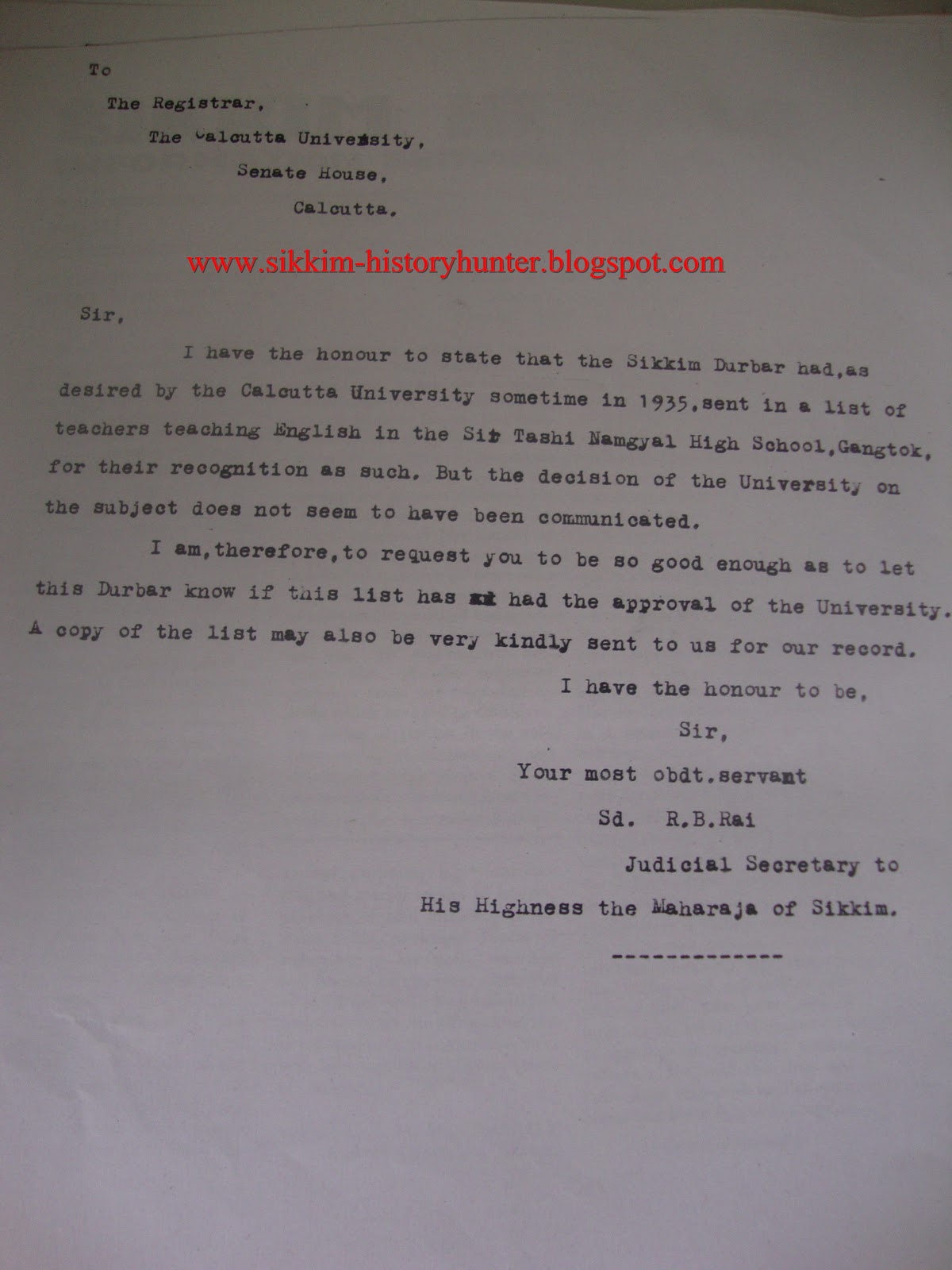
Letter of Sikkim Durbar to The Calcutta University (1935)

The modern system of education was adopted by the Government of Sikkim in the first decade of the last century. In my last post I have talked about the foundation of Gangtok School in 1906. The interesting fact about the then education system is that all the schools of Sikkim were affiliated to the Calcutta University. From the correspondence between the Judicial Secretary to His Highness the Maharaja of Sikkim and the Registrar Calcutta University it appears that, the appointment of the teachers in various schools of Sikkim was also watch over by the said University itself. The letter gives the impression that; a list of desired candidates was to be forwarded by the Sikkim Durbar to the University of Calcutta for the approval. As the endorsement letter of the University reached to the concerned department, the Sikkim Durbar had to assign them as the teachers in the different schools.

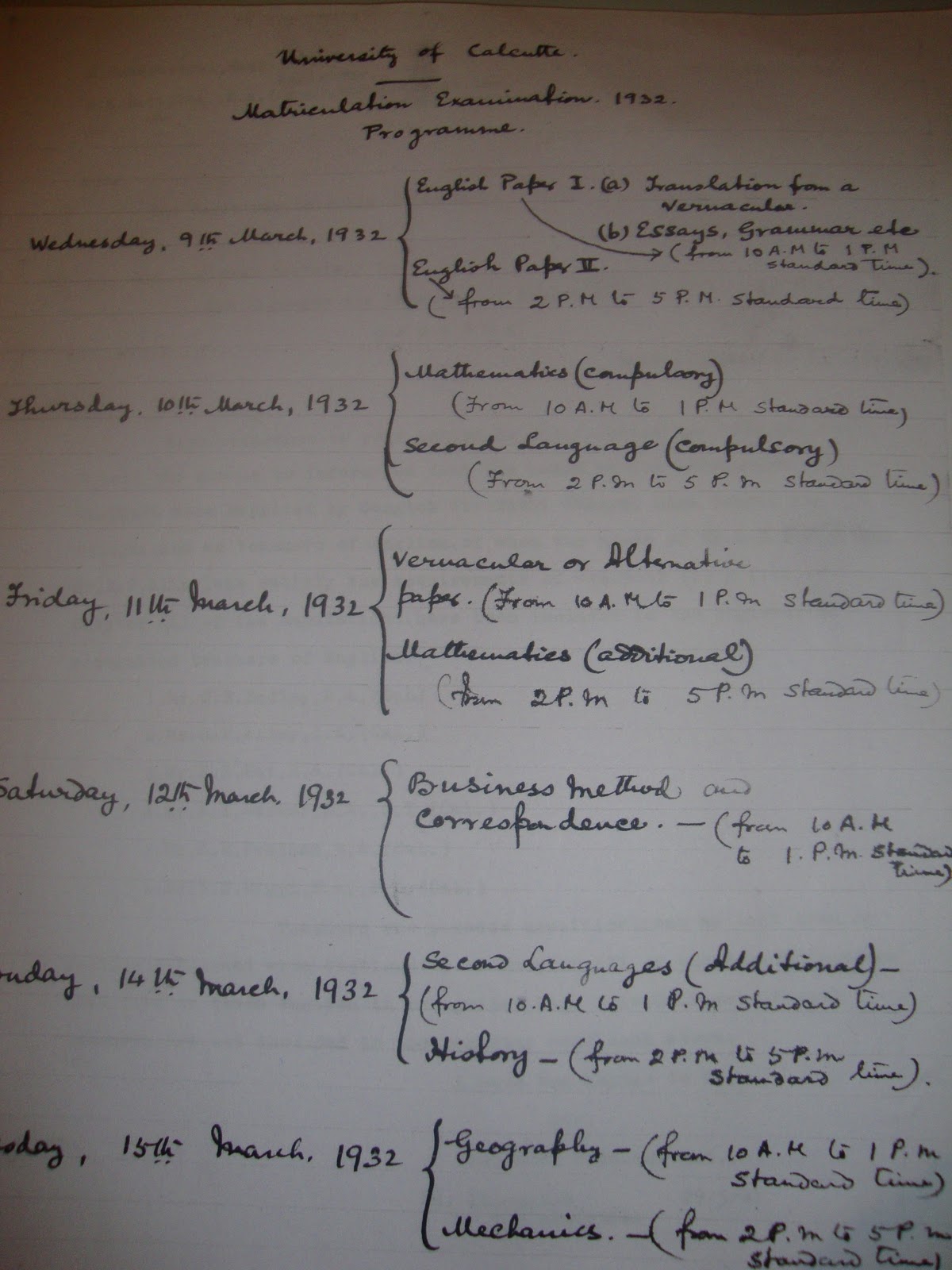
A hand written Hall Ticket of Calcutta University issued in 1932...


This hall ticket of Calcutta University is in all probability an oldest certificate as far as the education of Sikkim is concerned. Issued in 1932, the document has given detail information about the subjects that were taught at Calcutta University during the colonial era. The important feature of this hall ticket is that it is hand written. In that period, there were very few schools in Sikkim and most of them were providing education only up to the primary level. The first Government school of Gangtok was Gangtok School which was started in 1906, and this is where the late Maharaja of Sikkim, Sir Tashi Namgyal also studied as a first batch student. Later, the name of the Gangtok School was changed as Gangtok High School.
Before 1920, there were two Boarding Schools at Gangtok: The Bhutia Boarding School and The Nepali Boarding School. It was due to the diligent endeavor of late Rashmi Prasad Alley both the Schools were united which  later played a vital role for the foundation of first ever high school at Gangtok. The Gangtok High School was later named after the name of its first batch student and the then Maharaja of Sikkim Sir Tashi Namgyal. Though, with the efforts made by Lt. Rashmi Prasad Alley Gangtok got its first ever High school but, it was not an easy task for him to run it successfully. Due to the lack of higher institution in the proximity of the Kingdom, the only High School of Sikkim (Gangtok High School) was then affiliated to the Calcutta University.
 I am greatly indebted to Dr. Parshu Ram Poudyal Assistant Professor, Namchi Govt. College for sharing this valuable document with me. 

The pioneer of Nepali Education in Sikkim.....Rashmi Prasad Alley

Rashmi Prasad Alley was born in 1898 at a place called Gwalpara in Assam. He was a writer, a devoted teacher and a great devotee of the Nepali language. Lt. Alley was the first person to introduce the system of imparting education in Nepali language in Sikkim. He came to Sikkim in 1920 when the country was at the core of illiteracy, poverty and was crammed with the ignorant oppressed masses. There was no stipulation of giving out education in Nepali language in Sikkim when Lt. Alley came to Gangtok in 1920. He insisted the Royal Government to make a provision to convey education in the widespread language of the Sikkim Subjects. But, none of the authority paid any concentration to the ideas made by him. Aggravated from the Government’s retort he himself started to teach his students in their local tongue on every Saturday and Sunday at his own residence. After his meticulous attempt the Nepali language got its recognition among the masses which greatly helped for the expansion of the Nepali literature in Sikkim. 


Lt. Alley got his basic education in Bangla medium in Assam and taking Assamese as his key subject, he accomplished his High School in 1913. He did his Plus Two (then known as I.A) from Cotton College Guwahati. In 1919 he came to Darjeeling and worked for Chandrika (a Nepali News Paper Edited by Lt. Paras Mani Pradhan). It was in 1920; Lt. Alley got his appointment as a Head Master at Gangtok Boarding School. There were two Boarding Schools at Gangtok: The Bhutia Boarding School and The Nepali Boarding School. It was due to his diligent endeavor he was able to unite both the Schools and also played a vital role for the foundation of first ever high school at Gangtok. He worked as a teacher till 1941 at the Gangtok High School and during this period the system of dispensing education among the Nepali students started in Sikkim.
Apart from a teacher Lt. Alley was a great philanthropist who along with Raghu Bir Singh Basnett founded Dukha Niwarak Samity for the destitute. Lt. Alley was appointed as the Forest Minister in the ‘Popular Ministry’ of 1949. But, due to some circumstances the said Ministry was dissolved within 29 days of its formation.

(The photograph was taken in front of Gangtok Boarding School in 1930, Lt. Rashmi Prasad Alley can be seen in the middle row)