Sikkim Jewels: A Legacy of Royal Government of Sikkim Shuts Down


Pic: Sikkim Now

Sikkim Jewels Ltd. Was established in 1972 during the reign of its last Chogyal Palden Thondup Namgyal. The foremost intention of establishing such industry by the Royal Government of Sikkim was to cater to the demand of Watch Jewels and Cup Jewels. The Company had started with a very small capacity of producing 2.00 Lakhs of Cup Jewels and 1.50 Lakhs of Watch Jewels per month. It was established at Tadong Gangtok and is spread over 3.23 acres of land. Sikkim Jewels Ltd used to be the second oldest Company of the erstwhile Kingdom of Sikkim. The oldest of such Companies is Food Preservation Factory at Singtam established in 1956, during the reign of Maharaja Sir Tashi Namgyal, the reformist. The Company had strengthened its position in the market for Watch Jewels, Cup Jewels and Rotor Magnets. In all these products, it had obtained sizeable orders from all the leading manufacturers of India like Hindustan Machine Tools Ltd., Titan Industries Ltd., and Allwyn Watches Ltd., Jaipur Meters and Electricals Ltd., VXL India Ltd., and Andhra Pradesh Electricals and Equipment Corporation.
There was heavy recession in domestic market in all the three major items produced by Sikkim Jewels Ltd. Hence, the factory was running under its own capacity since 1997. Only in 2000-2001, the unit had been able to increase its production after receiving substantial orders from both domestic and international market. The unit produced a record of 30 Lakhs Watch Jewels in November 2000. Amid to its increase in production, the current world wide economic depression has compelled Sikkim Jewels Ltd. for an untimed demise.
The Daily Telegraph of March 11 2011 reports:
The Sikkim government has decided to wind up Sikkim Time Corporation, Sikkim Jewels Limited and Sikkim Precision Industries Ltd after attempts to revive the three loss-making public sector undertakings through private participation failed....... State commerce and industries secretary M.G. Kiran said the decision to shut down the three PSUs had been taken by the cabinet on March 2.

Kham Sum Ongdi the National Emblem of Monarchical Sikkim


Kham Sum Ongdi used to be the Royal as well as the National emblem of erstwhile Sikkim used by the ruling house of the Namgyals. It is not clear since when the emblem was used by the Sikkimese monarchs to sign the Royal Decrees and Proclamations. Possibly, it came into vogue after Sikkim’s contact with the British East India Company in the 30’s of 19th century. A shell, regarded as a holy article both by the Hindus and the Buddhists is at the top of the seal which is guarded by the two Gaduras that is considered as the vehicle used by Lord Vishnu, the protector of the extraterrestrial world by the Hindu and Buddhist mythology. The interesting feature of this Royal Emblem is that even after loosing its sovereignty, the State Government of Sikkim uses it as the Government insignia. The words Kham Sum Ongdi in Sikkimese Bhutia mean “Conqueror of the three realms”.

Lost Days of Sikkim Monarchs

Inside Father's Car- Prince Tenzing Namgyal and Prince Wangchuk Namgyal

Prince Tenzing Namgyal getting ready for a "Test Drive"?

Prince Tenzing Namgyal

Football is always a favorite sport in Sikkim- Prince Tenzing with his fellow players at the palace ground 
These pictures bear copyright of http://gxp1201.tibetcul.com (A website of People's Republic of China) I am greatly indebted to Tempa Transhimalayan Arts Taipei Taiwan for sharing link of these incredible pictures of erstwhile Himalayan Kingdom of Sikkim.  

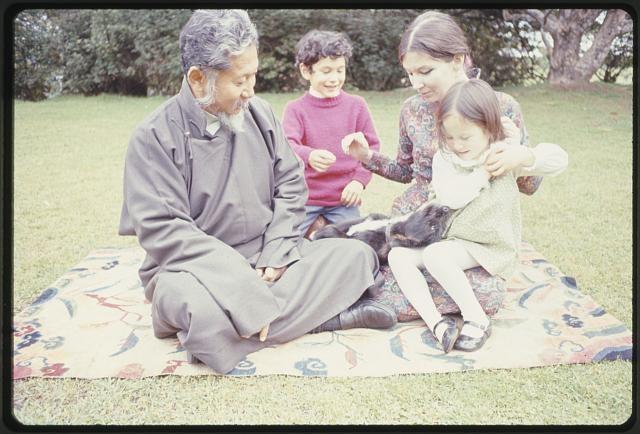
Incredible pictures of Hope Cooke Namgyal with Prince and Princess of Sikkim

Prince Palden Namgyal and Princess Hope Leezum of Sikkim 

Her Highness Hope Cooke Namgyal with Princess Hope Leezum


Princess Hope Leezum

Her Highness with the Prince

The Pride of being a mother- Her Highness with her children 
These pictures bear Copyright of http://gxp1201.tibetcul.com (A Website of People's Republic of China) I am greatly indebted to Tempa Trans-Himalayan Arts, Taipei Taiwan for sharing the link of these valueable photographs with me. 

Some Rare pictures of the Last Days of Sikkim Royals

A Royal Lady with Sikkim Guards

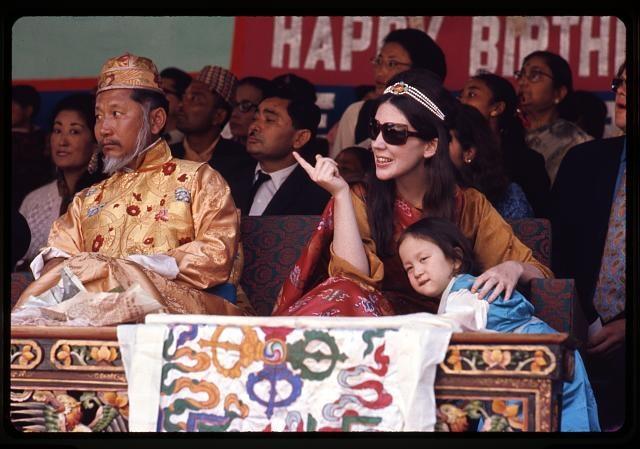
Chogyal Palden Thondup Namgyal & Hope Cooke Namgyal with princess Hope Leezum and Prince Palden

The Royal Couple at the King's Birthday

Gyalmo Hope Cooke Namgyal during her Reading Hours
The Chogyal being greeted by his subjects


Chogyal's beloved Hope-La
These pictures bear copyright of http://gxp1201.tibetcul.com (A website of People's Republic of China) I am greatly indebted to Tempa Transhimalayan Arts Taipei Taiwan for sharing the link of these valuable pictures with me.  

Some Rare Pictures of Her Highness Hope Cooke Namgyal- The Gyalmo of Sikkim


Her Highness at a Center of Technical Education  

Working on Buddhist Manuscript

Possibly at Namgyal Institute of Tibetology

Her Highness getting ready in National Costume 

Her Highness with Prince Palden

Her Highness attending a function

Her Highness at a  Hand loom center

Probably searching Sikkim's destiny in the Map of Asia

Her Highness in her reading room

In the palace   
These pictures bear copyright of http://gxp1201.tibetcul.com (A website of People's Republic of China) I am greatly indebted to Tempa Transhimalayan Art, Taipei, Taiwan for sharing the link of these incredible pictures with me.

Last Days of Sikkim Royals- The Chogyal and Gyalmo

The Chogyal and Gyalmo during a religious gathering at the Palace

Meeting commoners during Royal tours

The King with his beloved queen Hope-La

During Religious Celebration


During Rituals

On the palace lawn 

Chogyal and Gyalmo

The royal couple inside the palace
These pictures bear copyright of http://gxp1201.tibetcul.com  (A website of People's Republic of China)I am greatly indebted to Tempa Transhimalayan Art, Taipei, Taiwan for sharing the link of these incredible pictures with me. 

Old Pamphlet of Sikkim Congress (R)


Name of the Publisher on the back cover page 


Pic Voice of Sikkim 
Contents inside the Document 
The Cover of the Pamphlet 
This is a booklet circulated by Sikkim Congress (R) in the 80’s against the case filed by the State Government of Sikkim and Government of India against its President Shree Ram Chandra Poudyal.  This document contains 44 pages and is written in Nepali, the lingua-franca of Sikkim. It titles  R.C Poudyal viruddha Bharat Sarkar tatha Sikkim Sarkar- Sikkim Uccha Nyayalayama Hamro Muddha (The Indian and Sikkim Governments against R.C Poudyal- Our case at the Sikkim High Court). It deals with the protection and right implementation of Article 375 (f) of the Indian Constitution, which basically deals with the security of Old Sikkim Laws and Conventions. The booklet was published by Ram Lepcha, General Secretary of Sikkim Congress (R) and was printed at Vijay Printers, Tibet Road, Gangtok. The cost of this booklet was Rs 1. 

Late Lal Bahadur Basnet: An unforgettable figure of Sikkimese Politics


Lal Bahadur Basnet was born on 17th December 1926 at Nazitam, Sang in East Sikkim. Born to Lieutenant (Honorary) Prem Bahadur Basnett and Narbada Devi, Lal Bahadur Basnett is an enigmatic personality of Sikkimese politics. At the age of 4, Late Basnett, along with his parents, left Sikkim for Dehradun (then United Provinces now the Capital of Uttarakhand) and returned to his native land only after 15 years. He got his basic education at Dehradun and went to Ludhiana and admitted to Punjab University for his graduation. After accomplishing his Graduation, in 1945, he went to United Services Pre-Cadet College Belgaum.  He was court-martial from the Army due to his direct and open letter to a High ranking Army Officer. In his Letter he stated about “the dissatisfaction prevailing in 2/5 Ghurkha Rifles”, which was not engrossed by other high ranking Officers. He was sent for a rigorous three months imprisonment but, later released after spending one and a half months in the jail. After resigning from the Indian Army, he went to Pokhara (Nepal) and served as a school teacher.
He sat for the Sikkim’s first Civil Service Competitive Examinations and qualified the same by scoring more than 80% marks in both written and viva examination and was appointed as a Magistrate in 1961. His ideas of egalitarianism could not match with the monocracy. For him, the Sikkim Monarchy was standing on the fundamental principle of theocracy and chauvinism. In order to show his resentment against such system of Sikkim, Late Basnett resigned from his job and again went to Nepal. There too he sat for another competitive examination, which he cleared with a first position and got his job as Assistant Editor for a semi government English Bi-weekly “The Nepalese Perspectives”. Due to his immense faith on radicalism, which was visible in his writings, Late Basnett came under the direct surveillance of Nepali Monarchy and was put behind the bars for nearly 11 months. His days as a prisoner in the Nepali Jail paved the way for the writing of his famous novel “His Majesty’s Paying Guest” (Shree Panch ko Pahuna).
After getting expelled from Nepal Late Basnett came back to Sikkim and joined Sikkim National Congress, a political party headed by L.D Kazi. Very soon he was appointed as Joint Secretary of the Party and became an important element and was begun to be regarded as a “Think Tank” of the Sikkim National Congress Party. His ideas of democracy and egalitarianism could not stop there. In 1966, he published series of three articles on the topic of Democracy in Sikkim (Sikkim ma Prajatantra) which ultimately led to the portrayal of Late Basnett as an anti-national. He was sent to prison for using satirical and sardonic languages against the Sikkim Monarchy. Later he was granted a bail of Rs. 1 Lakh but, within a few days he was again sent to jail on the same alleged reason.  It was due to his endeavour the Sikkim National Congress had been able to win 10 out of 18 seats in the General Election of 1967. The sole credit of the victory goes to late Basnett for his political stalwartness.
Due to his deviating political views with L.D Kazi he resigned from the Sikkim National Congress and founded Sikkim Janata Party. Though, the party had never been active in the political sphere of Sikkim but, the demands made by Late Basnett and his party cannot be disregarded. After his victory in the election of 1979, he was elected as the Deputy Speaker of Sikkim Legislative Assembly.

Late Basnett as a Sportsman: During his youths he used to be a skilled sportsman. He participated at the National Boxing Championship in 1944 held at Irwin Stadium (now National Stadium) and became the first Sikkimese to become a participant in a national sports event. He was also a Captain of the Western Command Football Team in the Durand Cup in 1953. He is arguably the first Sikkimese football player to play at the National level.  
Late Basnett as a Writer: A part from a political figure, Late Basnett was a prolific writer as well. He has written many books which include Sikkim- A Short Political History (1974), His Majesty’s Paying Guest (1982), a collection of Nepali short stories Dharma Chada (1983) and The Ghurkhas of India are of importance. He has also written Rape of Sikkim a controversial book about the annexation of Sikkim by India. He wanted to publish it from India; therefore he replaced the word Rape with Merger. But, most unfortunately the Indian army seized his manuscripts at Bagdogra airport on his way to New Delhi in May 1978. Thus, this book of him remained unpublished.
Late Basnett as a Journalist: His writing habits did not allow him to sit ideal, after leaving the Editorship of “The Nepalese Perspectives” he made his tie-ups with Himalayan Observers an English Newspaper published from Kalimpong from 1967. He was also a founding editor of this Newspaper. His articles were published in many reputed newspapers of India like Blitz, Current, Himmat, Now and Surya. One of his short stories was also broadcast by BBC London in 1975 and the same story was published by a journal Imprint in 1976.
Due to lack of other relevant sources I am unable to mark the later part of his life. His other achievements will be updated as I will get further information. This article is written on the basis of an Appeal published by Sikkim Gorkha League Party for the Election of 1984. 

Old Election Manifestos of Sikkim

Election Manifesto of Sikkim Gorkha League for the Election of 24th December 1984

Continuation of the same

Appeal to the voters by Sikkim Gorkha League Party 

Election Symbol of Sikkim Gorkha League Party

Election Pamphlet of Sikkim United Independent Front for 1974 Election  
Further information about these two political stalwarts Late Lal Bahadur Basnett and Late Durga Prasad Rajalim will be updated soon. 

Pandit Nehru’s 24 hours visit to Sikkim on 28th December 1957


Pandit Jawaharlal Nehru, the first Prime Minister of Independent India also known as Chacha Nehru had a great admiration with the erstwhile Himalayan Kingdom of Sikkim.  During his tenure as the Prime Minister of India he has visited the tiny Himalayan Kingdom of Sikkim and had received approbation from its subjects. As per the report of Kanchenjunga, the first news based Nepali journal of Sikkim, the late Indian Prime Minister reached Rangpo, a bordering town (that bordered Sikkim with India) in the morning of 28th December 1957 on his way to Gangtok, the Capital of Kingdom of Sikkim. He was warmly welcomed by then Maharaja Sir Tashi Namgyal, the heir apparent Palden Thondup Namgyal, Nari K. Rustamji the Indian Dewan and the Executive Councillors of Sikkim Assembly. The journal further informs that the Indian Prime Minister was greatly welcomed by the people of Rangpo. “A crowd, busy in watching football match get into the town after hearing his arrival to wave their hands to the Prime Minister” the journal reports.  After the grand welcome at Rangpo Dak Bunglow, Pandit Nehru inspected the working at Rangpo copper Mining. He further insisted for the creation of own Indian machines for the development of such mines in Sikkim. After his brief visit to Rangpo Copper Mining the Indian Prime Minister visited Singtam Bazar and acknowledged the greetings made by the people of Singtam at School Phatak. At Singtam, he visited food preservation factory, constructed under the Seven Years Plan adopted by the Royal Government of Sikkim.
Indian Prime Minister Nehru at Palzor Namgyal Girls School 
He was also warmly welcomed by the people at 32 NO Ghattey School (now Brihaspati Parsai Sr. Sec School) Ranipool Golai, Deorali and Gangtok Bazar. The jeeps accompanying the Indian Prime Minister made several rounds of the capital clamouring the slogan of Panchseel Zindabaad.  On the same day, the Indian Prime Minister also visited Technical Institute, Tashiling Secretariat and STNM hospital and made a round of the Capital Town. In the evening, Pandit Nehru attended Garden Tea Party at Sikkim Palace hosted by the King Shree Panch Maharajadhiraj Sir Tashi Namgyal.
The report of Nehru's Visit to Sikkim published in Kanchenjunga 
The Report of Pt. Nehru’s visit was published in Kanchenjunga, (Vol.5 year 1957) the first News based journal of Sikkim. A copy of this journal is preserved by Shree Ganesh Kumar Pradhan of Rhenock at his private museum Ramgauri Sangrahalaya Rhenock East Sikkim)