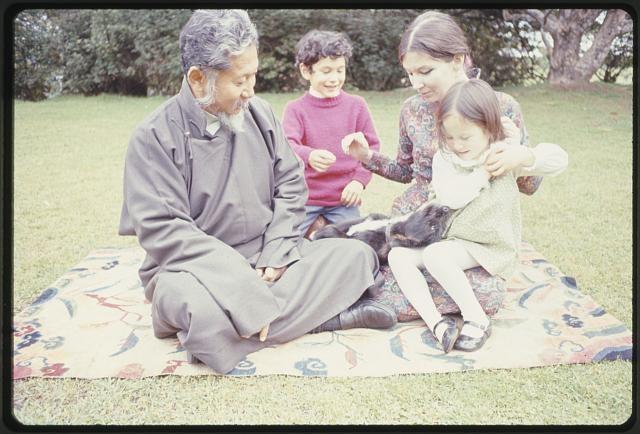
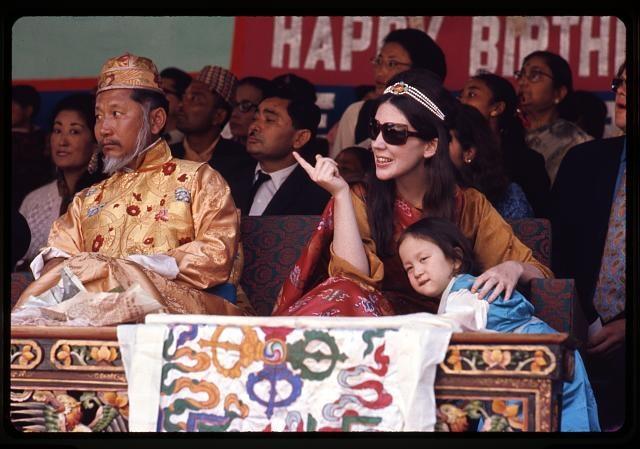
Incredible pictures of Hope Cooke Namgyal with Prince and Princess of Sikkim

Prince Palden Namgyal and Princess Hope Leezum of Sikkim 

Her Highness Hope Cooke Namgyal with Princess Hope Leezum


Princess Hope Leezum

Her Highness with the Prince

The Pride of being a mother- Her Highness with her children 
These pictures bear Copyright of http://gxp1201.tibetcul.com (A Website of People's Republic of China) I am greatly indebted to Tempa Trans-Himalayan Arts, Taipei Taiwan for sharing the link of these valueable photographs with me. 

Some Rare pictures of the Last Days of Sikkim Royals

A Royal Lady with Sikkim Guards

Chogyal Palden Thondup Namgyal & Hope Cooke Namgyal with princess Hope Leezum and Prince Palden

The Royal Couple at the King's Birthday

Gyalmo Hope Cooke Namgyal during her Reading Hours
The Chogyal being greeted by his subjects


Chogyal's beloved Hope-La
These pictures bear copyright of http://gxp1201.tibetcul.com (A website of People's Republic of China) I am greatly indebted to Tempa Transhimalayan Arts Taipei Taiwan for sharing the link of these valuable pictures with me.  

Some Rare Pictures of Her Highness Hope Cooke Namgyal- The Gyalmo of Sikkim


Her Highness at a Center of Technical Education  

Working on Buddhist Manuscript

Possibly at Namgyal Institute of Tibetology

Her Highness getting ready in National Costume 

Her Highness with Prince Palden

Her Highness attending a function

Her Highness at a  Hand loom center

Probably searching Sikkim's destiny in the Map of Asia

Her Highness in her reading room

In the palace   
These pictures bear copyright of http://gxp1201.tibetcul.com (A website of People's Republic of China) I am greatly indebted to Tempa Transhimalayan Art, Taipei, Taiwan for sharing the link of these incredible pictures with me.

Last Days of Sikkim Royals- The Chogyal and Gyalmo

The Chogyal and Gyalmo during a religious gathering at the Palace

Meeting commoners during Royal tours

The King with his beloved queen Hope-La

During Religious Celebration


During Rituals

On the palace lawn 

Chogyal and Gyalmo

The royal couple inside the palace
These pictures bear copyright of http://gxp1201.tibetcul.com  (A website of People's Republic of China)I am greatly indebted to Tempa Transhimalayan Art, Taipei, Taiwan for sharing the link of these incredible pictures with me. 

Old Pamphlet of Sikkim Congress (R)


Name of the Publisher on the back cover page 


Pic Voice of Sikkim 
Contents inside the Document 
The Cover of the Pamphlet 
This is a booklet circulated by Sikkim Congress (R) in the 80’s against the case filed by the State Government of Sikkim and Government of India against its President Shree Ram Chandra Poudyal.  This document contains 44 pages and is written in Nepali, the lingua-franca of Sikkim. It titles  R.C Poudyal viruddha Bharat Sarkar tatha Sikkim Sarkar- Sikkim Uccha Nyayalayama Hamro Muddha (The Indian and Sikkim Governments against R.C Poudyal- Our case at the Sikkim High Court). It deals with the protection and right implementation of Article 375 (f) of the Indian Constitution, which basically deals with the security of Old Sikkim Laws and Conventions. The booklet was published by Ram Lepcha, General Secretary of Sikkim Congress (R) and was printed at Vijay Printers, Tibet Road, Gangtok. The cost of this booklet was Rs 1. 

Late Lal Bahadur Basnet: An unforgettable figure of Sikkimese Politics


Lal Bahadur Basnet was born on 17th December 1926 at Nazitam, Sang in East Sikkim. Born to Lieutenant (Honorary) Prem Bahadur Basnett and Narbada Devi, Lal Bahadur Basnett is an enigmatic personality of Sikkimese politics. At the age of 4, Late Basnett, along with his parents, left Sikkim for Dehradun (then United Provinces now the Capital of Uttarakhand) and returned to his native land only after 15 years. He got his basic education at Dehradun and went to Ludhiana and admitted to Punjab University for his graduation. After accomplishing his Graduation, in 1945, he went to United Services Pre-Cadet College Belgaum.  He was court-martial from the Army due to his direct and open letter to a High ranking Army Officer. In his Letter he stated about “the dissatisfaction prevailing in 2/5 Ghurkha Rifles”, which was not engrossed by other high ranking Officers. He was sent for a rigorous three months imprisonment but, later released after spending one and a half months in the jail. After resigning from the Indian Army, he went to Pokhara (Nepal) and served as a school teacher.
He sat for the Sikkim’s first Civil Service Competitive Examinations and qualified the same by scoring more than 80% marks in both written and viva examination and was appointed as a Magistrate in 1961. His ideas of egalitarianism could not match with the monocracy. For him, the Sikkim Monarchy was standing on the fundamental principle of theocracy and chauvinism. In order to show his resentment against such system of Sikkim, Late Basnett resigned from his job and again went to Nepal. There too he sat for another competitive examination, which he cleared with a first position and got his job as Assistant Editor for a semi government English Bi-weekly “The Nepalese Perspectives”. Due to his immense faith on radicalism, which was visible in his writings, Late Basnett came under the direct surveillance of Nepali Monarchy and was put behind the bars for nearly 11 months. His days as a prisoner in the Nepali Jail paved the way for the writing of his famous novel “His Majesty’s Paying Guest” (Shree Panch ko Pahuna).
After getting expelled from Nepal Late Basnett came back to Sikkim and joined Sikkim National Congress, a political party headed by L.D Kazi. Very soon he was appointed as Joint Secretary of the Party and became an important element and was begun to be regarded as a “Think Tank” of the Sikkim National Congress Party. His ideas of democracy and egalitarianism could not stop there. In 1966, he published series of three articles on the topic of Democracy in Sikkim (Sikkim ma Prajatantra) which ultimately led to the portrayal of Late Basnett as an anti-national. He was sent to prison for using satirical and sardonic languages against the Sikkim Monarchy. Later he was granted a bail of Rs. 1 Lakh but, within a few days he was again sent to jail on the same alleged reason.  It was due to his endeavour the Sikkim National Congress had been able to win 10 out of 18 seats in the General Election of 1967. The sole credit of the victory goes to late Basnett for his political stalwartness.
Due to his deviating political views with L.D Kazi he resigned from the Sikkim National Congress and founded Sikkim Janata Party. Though, the party had never been active in the political sphere of Sikkim but, the demands made by Late Basnett and his party cannot be disregarded. After his victory in the election of 1979, he was elected as the Deputy Speaker of Sikkim Legislative Assembly.

Late Basnett as a Sportsman: During his youths he used to be a skilled sportsman. He participated at the National Boxing Championship in 1944 held at Irwin Stadium (now National Stadium) and became the first Sikkimese to become a participant in a national sports event. He was also a Captain of the Western Command Football Team in the Durand Cup in 1953. He is arguably the first Sikkimese football player to play at the National level.  
Late Basnett as a Writer: A part from a political figure, Late Basnett was a prolific writer as well. He has written many books which include Sikkim- A Short Political History (1974), His Majesty’s Paying Guest (1982), a collection of Nepali short stories Dharma Chada (1983) and The Ghurkhas of India are of importance. He has also written Rape of Sikkim a controversial book about the annexation of Sikkim by India. He wanted to publish it from India; therefore he replaced the word Rape with Merger. But, most unfortunately the Indian army seized his manuscripts at Bagdogra airport on his way to New Delhi in May 1978. Thus, this book of him remained unpublished.
Late Basnett as a Journalist: His writing habits did not allow him to sit ideal, after leaving the Editorship of “The Nepalese Perspectives” he made his tie-ups with Himalayan Observers an English Newspaper published from Kalimpong from 1967. He was also a founding editor of this Newspaper. His articles were published in many reputed newspapers of India like Blitz, Current, Himmat, Now and Surya. One of his short stories was also broadcast by BBC London in 1975 and the same story was published by a journal Imprint in 1976.
Due to lack of other relevant sources I am unable to mark the later part of his life. His other achievements will be updated as I will get further information. This article is written on the basis of an Appeal published by Sikkim Gorkha League Party for the Election of 1984. 

Old Election Manifestos of Sikkim

Election Manifesto of Sikkim Gorkha League for the Election of 24th December 1984

Continuation of the same

Appeal to the voters by Sikkim Gorkha League Party 

Election Symbol of Sikkim Gorkha League Party

Election Pamphlet of Sikkim United Independent Front for 1974 Election  
Further information about these two political stalwarts Late Lal Bahadur Basnett and Late Durga Prasad Rajalim will be updated soon. 

Pandit Nehru’s 24 hours visit to Sikkim on 28th December 1957


Pandit Jawaharlal Nehru, the first Prime Minister of Independent India also known as Chacha Nehru had a great admiration with the erstwhile Himalayan Kingdom of Sikkim.  During his tenure as the Prime Minister of India he has visited the tiny Himalayan Kingdom of Sikkim and had received approbation from its subjects. As per the report of Kanchenjunga, the first news based Nepali journal of Sikkim, the late Indian Prime Minister reached Rangpo, a bordering town (that bordered Sikkim with India) in the morning of 28th December 1957 on his way to Gangtok, the Capital of Kingdom of Sikkim. He was warmly welcomed by then Maharaja Sir Tashi Namgyal, the heir apparent Palden Thondup Namgyal, Nari K. Rustamji the Indian Dewan and the Executive Councillors of Sikkim Assembly. The journal further informs that the Indian Prime Minister was greatly welcomed by the people of Rangpo. “A crowd, busy in watching football match get into the town after hearing his arrival to wave their hands to the Prime Minister” the journal reports.  After the grand welcome at Rangpo Dak Bunglow, Pandit Nehru inspected the working at Rangpo copper Mining. He further insisted for the creation of own Indian machines for the development of such mines in Sikkim. After his brief visit to Rangpo Copper Mining the Indian Prime Minister visited Singtam Bazar and acknowledged the greetings made by the people of Singtam at School Phatak. At Singtam, he visited food preservation factory, constructed under the Seven Years Plan adopted by the Royal Government of Sikkim.
Indian Prime Minister Nehru at Palzor Namgyal Girls School 
He was also warmly welcomed by the people at 32 NO Ghattey School (now Brihaspati Parsai Sr. Sec School) Ranipool Golai, Deorali and Gangtok Bazar. The jeeps accompanying the Indian Prime Minister made several rounds of the capital clamouring the slogan of Panchseel Zindabaad.  On the same day, the Indian Prime Minister also visited Technical Institute, Tashiling Secretariat and STNM hospital and made a round of the Capital Town. In the evening, Pandit Nehru attended Garden Tea Party at Sikkim Palace hosted by the King Shree Panch Maharajadhiraj Sir Tashi Namgyal.
The report of Nehru's Visit to Sikkim published in Kanchenjunga 
The Report of Pt. Nehru’s visit was published in Kanchenjunga, (Vol.5 year 1957) the first News based journal of Sikkim. A copy of this journal is preserved by Shree Ganesh Kumar Pradhan of Rhenock at his private museum Ramgauri Sangrahalaya Rhenock East Sikkim)

Antique Lepcha House at Tashiding Chongrang


The Old Lepcha at Chongrang
Antiques and artifacts have always fascinated me since my childhood which was possibly the rudiments in my unripe infant mind for an advanced historical investigation in my days to come. I have just loved these relics and have always enjoyed their structural designs. They are just awe-inspiring and are the bystanders of the “massive alter” which has utterly changed the very face of a human society. During my Post Graduate  Days in Pune University, I always enjoyed to sit and study at Saniwarwada, the remains of the erstwhile palace of the Peshwas. Though, it was burnt down by the British after their antagonism with the Peshwas, but it still has many features to drag the attention of a history lover. The other such structures where I always wanted to visit in Pune were Vishrantawadi, Aga Khan Palace, Deccan College, and Ferguson College and so on. They have always inspired me to love such remains with a great sense of respect.
There are many such antiques scattered throughout the state of Sikkim, but, our tendency of chirping into the History of Sikkim from the windows of marvellous edifice of Gangtok has compelled such antiques to remain behind the curtail. It is an irony to say that the objects of historical importance are not dragging any attention of any NGOs and authorities. This is a tale of an old Lepcha House, counting its last days, situated at Chongrang at Tashiding in West Sikkim. The present owner of the said Lepcha House is Mr. Tshwang Tashi Lepcha. He has informed us that it was constructed somewhere 140 years before by his great grand father. If we have to believe on his aphorism, the House was constructed in 1871 and bears all the traditional features of a Lepcha House.
Plastic Cover- A temporary measure
The old Lepcha structural design is standing on the huge log pillars on every corners of the foundation. For the further support to the house, stone walls on the two sides are constructed and has left open to serve other village purpose like keeping the ripe crops or may say keeping livestock during rainy season and so on. Above the walls and wooden pillars rooms were separated for the residential purpose. The floor in the upstairs is made up of firewood, which are kept crisscrossing each other. This sort of built-up not only makes a structure strong but also provides warmth to fight against the chilling winters.
The roof of the House
The most interesting part of this house is indeed its roof which is still covered with Siru (a local grass used by Sikkimese peasantry to serve the purpose of covering a house or shed). I still can remember my childhood days when we too had a house which had a roof of Siru and during rains it had considerable leaching. To tie up the said grass with the bamboo piece, the ancient Lepchas had use Choya (a thread made by pilling a bamboo). To give a final touch to the roof, they used Choya in a most synchronising manner so that the grass could remain intact to protect the house from seepage.
Another striking feature of this house is that it was constructed without using a single nail. To keep other beams and woods firmly, they made holes on the huge wooden pillars so that it could remain at the exact place where it was suppose to be. The floor of firewood was pasted by a thick layer of clay that could give them warmth and they could also keep fire burning the whole night during winters.
Mr. Tshewang Tashi Lepcha-the present owner
This old Lepcha House is at the verge of its demise and its owner, Mr. Tshewang Lepcha is unable to maintain it due to his poverty. The stones of its wall are getting away from their places and its roof has got many holes. He has now made a temporary arrangement by covering its roof by a plastic to keep his family members safe from the rain. Likewise, the floor is decaying and to get rid of it the owner is still following traditional method of pasting those patches with clay. This house needs an immediate attention from the concerned authorities or else it will be decayed within a few years. 

Mr. Bal Bahadur Rai: An Artist of Passion


Nepali Ladies- A Work of B.B Rai
 It is said that each acts of an individual is an art and such acts of human always have some artistic values. The human history has witnessed such behaviours of human society from time immemorial. The arts and objet d'art of Indus valley Civilization, Egyptian Civilization, Chinese Civilization and even before it, the anonymous and indecipherable arts of the Stone Age has rendered us some important information for the study of human history. Therefore, art in human society exists since the evolutionary period and has played an important role in expressing hidden feelings of an individual or in many cases the feelings of a whole society. This is also a story related to an artist, or in a truer sense a watercolourist of Sikkim, who has been able to stand himself on a distinct platform of the whole artist fraternity.
Best Painter Award 2007
Mr. Bal Bahadur Rai, popularly known as B.B. Rai was born on 4th May 1950 at Tinzir Busty, Namchi in South Sikkim. He was the youngest son of late Jaharman and late Ashalacchi Rai. Mr. Rai got his elementary education at Namchi under the guidance of the important pillar of Sikkimese Nepali literature Late Agam Singh Tamang “Apatan”. In 1959, Mr. Rai got stipend from the Ministry of Foreign Affairs, Government of India and went to Birla Vidhya Mandir Nainital for his further education. For his outstanding performance in Matriculation in 1966, the Uttar Pradesh Government had provided him scholarship for his further studies but, he could not continue his studies due to some personal circumstances. After accomplishing his matriculation from Birla Vidhya Mandir, Mr. Rai came back to Sikkim and completed his B.Sc. from Darjeeling Govt. College and started his service to the state as a teacher.
Chogyal Palden Thondup Namgyal with Hope Cooke
Smoking Devkota
During his stay at Nainital, the eminent figure of Indian Cine world, Mr. Danny Denzongpa used to be his senior. It is from Mr. Rai, I have been able to secure much information about our own Danny. While asking about his inclination towards painting, Mr. Rai has told me that he used to make various arts on the Biskun (food grain kept in a courtyard for drying purpose) and was fond of his eldest brother late Kabirman Rai, who also used to be an artist of repute. The only question when should I be a good artist? used to reign the infant mind of Mr. Rai. His childhood task was to look after the Biskun, where he got plenty of time to spend in making sketches of various characters. Thus, a Sikkimese artist grew up at the courtyard making various sketches on Biskun. His talent is noticeable in Vatayan, a monthly magazine of Tilak House of Birla Vidhya Mandir Nainital. This magazine was published by the Tilak House of the school on the occasion of 107th Birth Anneversary of Lokmanya Bal Gangadhar Tilak in July 1963. As a student of Class VII, Mr. Bal Bahadur Rai has made a beautiful sketch of Lokmanya Tilak in the front page of the said magazine. His proficiency of art as a young artist is clearly manifested in the sketch of Lokmanya.
Mr. Rai, continued his passion of painting even after his service and has received many awards and certificates both from the state and central art academies. One of his paintings was among the fifth best paintings in an exhibition BRUSH STROKE hosted by Sikkim Academy in 2005. Further, he has exhibited his paintings in various places and has been able to receive approbation from the visitors throughout the country. He is also the founding President of Indradhanush Chitrakala Sanstha and is also associated with various art forums of the state and of the nation. He was also awarded as the Best Painter on the eve of State Day by the Government of Sikkim in 2007.
Portrait of Lepcha Bhutia & Nepali 
Apart from a watercolourist, Mr. Rai is also a versatile singer. Though, he has not recorded any songs so far, but has some remarkable experiences about his singing. During the visit of Shree Panch Maharajadhiraj Mahendra Bir Vikram Shah Dev, the former king of Nepal to Birla Vidhya Mandir, Nainital in 1965, Mr. Rai sang a Nepali song  Swadeshko Mayale aaja Mero Man Rulayo. The lyric of this song was penned by his ideal teacher Late Agam Singh Tamang “Apatan”. His Majesty the king of Nepal got poignant after listening to this song performed by Mr. Rai. There were many other fellows from the mainland of India who were also in the group to sing the Nepali song in the respect of His Majesty the King of Nepal. From his talks it appears that the students of Sikkim at Birla Vidhya Mandir used to be excessively talented.
Jesus Christ being taken out of the Cross
Portrait of Bal Gangadhar Tilak by B.B. Rai on Vatayan 1963 
After getting voluntary retirement as a Joint Director Planning and Development, Government of Sikkim, Mr. B.B Rai has dedicated himself in painting. His favourite is oil painting but his brush has touched all the other rivulet of paintings as well. His portrait of Smoking Devkota is indeed the best of its kind and also a new imagination of him. Similarly, the painting of Jesus, in which Mr. Rai has featured the corpse of Jesus, is taking out from the Cross by his followers. I have seen many paintings of Lord Jesus that also includes the Last Supper, but, this painting by Mr. Rai is a new and novel for me. Likewise, the painting featuring last Chogyal Palden Thondup Namgyal and his Queen Hope Cooke of Sikkim is a beautiful creation of Mr. Bal Bahadur Rai. Here I am reminding the famous saying of Bal Krishna Sama, the eminent writer of Nepali literature “Hey Ishwar, yedi pratibha garibko Jhopadi mai janmincha bhane malai aajha dukha dey”... Oh God!! If a calibre only borns in the hut of a poor; make me broke.