Schooldays drawing of Danny Denzongpa


A Peacock- Danny's Love towards Nature 
Tshering Pintso Bhutia popularly known as Danny Denzongpa is a famous name in the Bollywood. We have seen him in many Indian movies as a deleterious villain and also have listened to many songs sung by him in Indian and Nepali films. I still can remember a Nepali song of my childhood days “Agi Agi Topaiko Gola...Pachi pachi machine gun Bha ra ra...Cigarette nadeu ma bedi khanelai Maya nadeu ma hedi janelai” sung by him with Asha Bhosle, a gigantic name in the Hindi music world.  His journey from the remote village of Yoksam to Mumbai is possibly the best example for all those who aspire to be a noted figure in Bollywood. Danny started his schooling from Gyalshing, the District Headquarters of West Sikkim. After getting stipend from the Ministry of  Foreign Affairs Government of India, he went to Birla Vidhya Mandir Nainital.
The original name of Danny is visible in this sketch 
I have met one of his juniors of Birla Vidhya Mandir Mr. B. B. Rai of Namchi Kazitar, from whom I have been able to secure an old school magazine Vatayan. It was a monthly magazine of Tilak House of the said school, published in July 1963.  The said magazine was published on the 107th birth anniversary of Lokmanya Bal Gangadhar Tilak by the Tilak House of Birla Vidhya Mandir Nainital. It is to be mentioned here that most of the Sikkimese students used to be in this House of the School. The Sikkimese students studying at Birla Vidhya Mandir were of great talents. Apart from their studies, our boys had astonishing calibre of writing, painting and singing. After accomplishing their education they all have served Sikkim through their distinct services. Mr. B.B Rai, alumni of Birla Vidhya Mandir has served in many Departments under Government of Sikkim before getting Voluntary Retirement as a Joint Director Planning and Development Department. He is an artist of a great reputation.


Sketch of a porter by Danny Denzongpa
In this monthly magazine, I have been able to stumble on few sketches made by our own Danny during his school days. The sketches of Danny speak more than thousand words. In one of his sketches he has portrayed about a student’s life in a hostel during a rainy night. In another drawing, he has featured the toil of a porter carrying a sack of potato towards his hostel. The practice of carrying loads on the back of a manual labour is still prevalent in Nainital. Mr. B.B Rai informed me that, frequently they had to have potato in their hostel as sabji and the potato sacks were brought to the school hostel by the porters. In his sketch Danny has featured the efforts of such meagre.  His third painting shows his love towards nature. This is a sketch of a peacock. His extraordinary talent is visible in every sketches made by Danny in his schooldays. In his arts his image of deleterious villain of Bollywood is silent rather; a great and a pious Buddhist soul is visible which could understand the pricks and pains of the meagre and nature. Apart from a gigantic figure of Bollywood and a sketcher, Danny is also a good flute player. 

Jaharman Rai: The unsung Hero of Sikkimese History

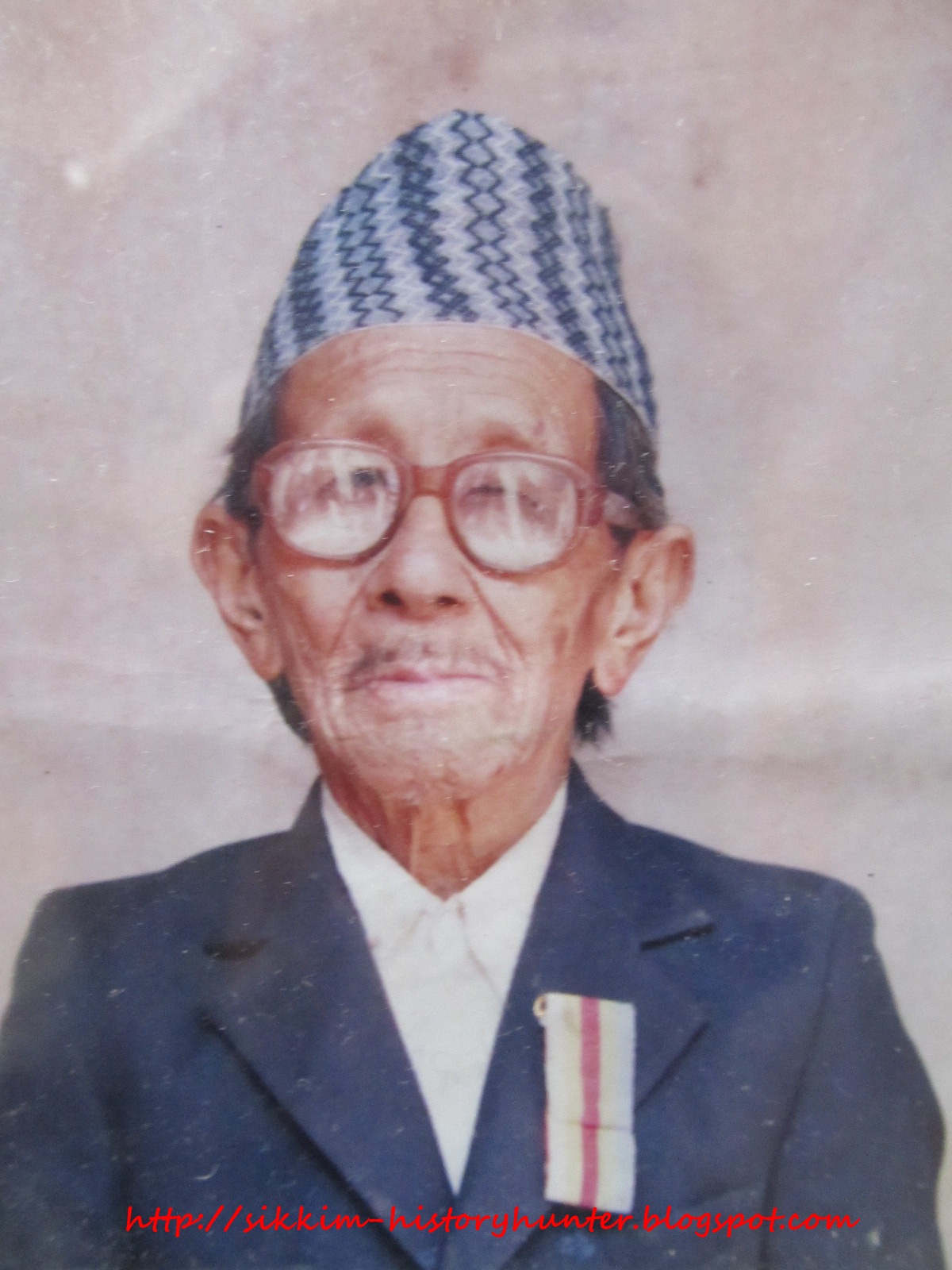
Late Jaharman Rai
The ordinary people have always played an indispensable part for the development of human society by producing agricultural items, rendering free services for the constructive works of a state and by providing forced labour. Further, by paying tax and rent of the land and agricultural products they make a greater contribution for the economic prosperity of a country. Being the nucleus of human development, the peasants in particular and ordinary people in general, who are always in a larger number, have never been treated at par. It is not only a case of a particular province or a state or a country, injustice against the peasant is a phenomenon which is rampant in every nook and corner of the world. The pricks, pains and the wounds the peasants have been subjected to in the past are simply irreparable which are very much similar throughout the globe. Their service to mankind in general and their Landlords or the Kings in particular, the burden of taxation upon them, the yoke of forced labour on their shoulders share a similar nature and feature throughout the earth. Amidst their large contribution, they have been frequently ignored not only by the authorities in the past but by history as well. Further, history of ordinary people which also covers resistance made by the peasants is always regarded as a sundry event by the contemporary historians. This is the major reason why the hardships of the peasants in the past have not got their mention in the pages of history. To quote Howard Zinn “...not only to the orthodox history of those years, but to the very idea of history told from the point of view of the authorities- a history confined to the “important” people that ignores the struggle of ordinary people”. In reality, it is an irony to monitor that human society is driven by a marginal force. It may be in the case of chieftaincies or later in the case of large empires; the majority have always been administered by the minority. In a truer sense, the suppression of the voices of the powerless or the marginalized, which always form the major group, continues even in today’s so called democratic set-up. The government, which is in minority, hardly bothers to listen what the majority are asking for and arrangements for settling the dilemma that occurs frequently between the minority governed state and majority of interests is seldom seen.
Late Rai on Second Row L-R during the construction of Sikkim House in New Delhi
Hence, being a student of history, this is my unpretentious attempt to bring into light about those unseen heroes of Sikkim who have contributed a lot for the erstwhile kingdom but are forgotten by the pages of History. I prefer to articulate them as the Unsung Heroes of our society, which was a composition of the ordinary people and peasants, and that never made any headlines in the leading newspapers and journals to drag the attention of the elites. For me, they are the real contributors, the altruistic and the most selfless human folks who played an important part in the development of Sikkimese society by dint of their labour and hard works.
Late Jaharman Rai was also a son of an ordinary Sikkimese peasant of Tinzir Busty at Namchi in South Sikkim. Born on 2 July 1915, Late Rai was the youngest child of Late Ashdhan Rai. After the death of his father, Late Jaharman Rai took up the task of tax collector under Lahso Kazi and later under Tenzing Wangdel Lahso. After witnessing the deplorable condition of the peasants during his service, he made his mind to resign from the job. The condition of Sikkimese peasantry thence was at a wretched stage, where they not only had to pay the tax but also had to carry Kalobhari and Jharlangi, the most crooked system devised by the Colonial Government. When the peasants failed to pay their taxes, their household items were auctioned of which they could not object as they were under the strict surveillance of the Kazis and the Zamindars, the self-styled super class of the erstwhile Sikkim.  
When the level of repression reached beyond the tolerance of the ordinary Sikkimese, they founded the first ever political party of Sikkim which was known as Rajya Praja Sammelan. This party, though it lacks agenda and ideology, is regarded as the first political party of the erstwhile Himalayan Kingdom of Sikkim. Late Jaharman Rai joined this party and became an active cadre. Later, the Praja Sammelan along with other two political parties namely, Praja Mandal and Praja Parishad was united to form Sikkim State Congress in December 1947. After the foundation of Sikkim State Congress, Late Rai continued to play an important part to ignite the slumbered minds of Sikkimese peasantry. He became the Secretary of Namchi branch of Sikkim State Congress for achieving the determined goal of democracy in the Kingdom. His correspondence with Late Pratiman Rai, Late Kashiraj Pradhan and Late Jainarayan Sapkota reveals his active participation in the people’s movement that was launched by Sikkim Sate Congress. Further, Late Jaharman Rai had also played a key role in raising party fund for the Sikkim State Congress.
Lhaksam Shabdek Badhar- The Silver Medal presented by the Chogyal of Sikkim
Apart from the politics, Jaharman Rai is also remembered for his philanthropic works at Namchi. Due to utter poverty he could not get his formal education and learnt to write in Nepali in bamboo tablets as a shepherd. Therefore, to annihilate such hurdles in education, he managed a night school at Tinjir which is now raised up to a Junior High School. Further, in the unparalleled landslides occurred from 3rd to 5th October 1968, which is popular in Sikkim as adshat shaal ko pairo, Late Rai had given refuge to many of his co-villagers in his house. He arranged Government help in the form of edibles, household items and beddings for the affected people of the catastrophe. It was under his guidance and initiative the citizens of Tinzir and Kamrang, reconstructed the brush off roads between Jorethang, Melli and Gangtok after the catastrophe. Recognising his social services, the Chogyal of Sikkim Late Palden Thondup Namgyal rewarded him with the Service Medal (Lhaksam Shabdek Badhar) in 1969.
Further, Late Jaharman Rai was a skilled craftsman, whose dexterity is visible at the Old Sikkim House, New Delhi which was known as Sikkim Residency before its merger with India. Still one can notice the huge sign board of “Sikkim Residency” in front of the Old Sikkim House. Most of the wooden works there is the creation of Late Jaharman Rai. In 1971, he led a group of Sikkimese craftsmen to give a typical Sikkimese look to the Residency.
Though he passed away in 2009, at the age of 94, his works are still alive at the Old Sikkim House helping the mainstream people to understand Sikkim in a better way. Sikkim is always proud of having such ordinary, but significant characters in its past. The history of ordinary people is also thus important like the history of “essential” people and their contribution should never be underestimated.


Charles Alfred Bell: The Second British Political Officer of Sikkim


C A Bell -The second Political Officer of Sikkim

Charles Alfred Bell was born in Calcutta (now Kolkata) India, on 31 October 1870 - the son of Henry Bell of the Indian Civil Service (ICS). He was Educated at Winchester school and New College, Oxford. After accomplishing his studies, Charles also joined the ICS in 1891 and spent the next nine years in various posts in Bengal, Bihar and Orissa, before being transferred to Darjeeling in 1900. It was in Darjeeling; Bell came to be familiar with the Tibetans settled there and began to learn their language. His devotion towards the Tibetan language leads to the publication of his first book, A Manual of Colloquial Tibetan, a two-part grammar-phrase book and dictionary in 1905.
Gangtok British Residency picture taken by C A Bell

 Apart from a Tibetan scholar, Bell also had a passion of photography. During his stay in Tibet, he has taken many photographs related to the daily lives of the Tibetans, which are greatly helpful for the study of Tibetan culture and civilization. In 1904-5 he was put in charge of administration of the Chumbi Valley, which had been temporarily ceded by Tibet to Britain under the terms of the Younghusband Mission. It has to be mentioned here, the Chumbi valley was once a part of Sikkim which was later transferred to Tibet after the Anglo-Chinese convention.

After the retirement of Sir James Claude White, Charles Bell was appointed as the Political Officer of Sikkim in 1908. The most momentous event during Bell's tenure as Political Officer was meeting the Thirteenth Dalai Lama in 1910. Due to the political hostility between the Chinese and the Tibetans his Holiness the 13th Dalai Lama was forced to flee Tibet and he sought refuge in Sikkim. As Political Officer of Sikkim, Bell provided necessary assistance to his Holiness during his exile. The two formed an intimate and lasting friendship, which later proved objectionable to the British in their future negotiations and dealings with Tibet after the Dalai Lama's return to Lhasa in June 1912.
Bell continued as Political Officer for Sikkim, Bhutan and Tibet until 1918. During this time he continued his communications with the 13th Dalai Lama and advised him on the modernization policies he was developing for Tibet. Bell was widely acknowledged in British circles as the primary authority on Tibetan matters at this time.
Sky burial in Tibet Pic. C A Bell
After 1918 Bell took leave from the Civil Service and devoted himself to the study of Tibet, spending the next two years in Darjeeling. Although for many years he had an open invitation from the 13th Dalai Lama to visit Lhasa, the British Government did not allow him to do so. In 1920 Bell was finally given Government permission to visit the Tibetan capital as part of a diplomatic mission, arriving in Lhasa on 17 November. Bell's role was to advise the Tibetans on foreign policy. "The Dalai Lama showed his more than friendly intentions by receiving Sir Bell, at the very first interview, informally, sitting with him at a small table in his private apartment, with no witness present.
Nepalese in Lhasa Pic. Charles Bell 
Bell remained in Lhasa for the best part of a year. After his return, in 1921, he left the ICS and applied himself to writing about Tibet. In his retirement, Bell published several books on Tibetan culture and history - Tibet: Past and Present (1920), followed by The People of Tibet (1928), and The Religion of Tibet (1931). Bell also continued his personal correspondence with the Dalai Lama.
In 1934 Bell returned to Tibet once again and this time with his wife, Cashie. Unfortunately he was too late to meet his old friend again, for the 13 th Dalai Lama had passed away in December 1933. Bell continued his travels in Central Asia during the next few years visiting Mongolia, Manchuria and Siberia. Fittingly, Bell's final work was a result of the strong bond that he had formed with the 13 th Dalai Lama since their first meeting in 1910. The book, Portrait of the Dalai Lama, was completed only a few days before his death in Canada (where he had recently migrated) on 8 March 1945.
Picture of Rabden Lepcha who accompanied Bell during his visit to Lhasa 
Sir Charles Bell was probably the most influential British officer to serve in Tibet. He set the groundwork for Anglo-Tibetan relations, and his visit to Lhasa in1920 paved the way for subsequent British officials to travel to Tibet. Bell's strength lay in the way he was able to immerse himself in Tibetan culture and language, becoming, in his own words, "in a large measure Tibetanised". This earned him the respect and acceptance of the many Tibetans. As one Tibetan official "When a European is with us Tibetans I feel that he is a European and we are Tibetans; but when Lonchen Bell is with us, I feel that we are all Tibetans together".
The above article is compiled by Claire Freeman, Curatorial Assistant, Pitt Rivers Museum (Emphasis added) http://tibet.prm.ox.ac.uk/tibet_Charles_Bell.html. The photographs with this post bears copyright of Pitt Rivers Museum University of Oxford. 


B B Gurung- The Third Chief Minister of Sikkim (11th May 1984-24th May 1984)


Mr. B B Gurung, the third Chief Minister of Sikkim was born on 11th October 1929 at Chakhung village in West Sikkim. After accomplishing his Graduation from Calcutta University, Mr. Gurung worked as a teacher at Turnbull School Darjeeling for a short period.  He then returned to Sikkim and continued the same profession as a teacher and worked at Rangpo High School. After few years he left the job of teacher and worked as a Staff Reporter for Amrita Bazar Patrika a Calcutta based newspaper. He has also edited Kanchenjunga the first news based Nepali journal of Sikkim.

He began his political career as a member of Sikkim State congress (founded in December 1947). Very soon he was given the charge of General Secretary of the Party. Later, he was elected as a Councilor from Chakhung Constituency. As a Councilor, Mr. Gurung was given the charge of Education, Forest and Transportation Department.
Mr. B.B Gurung pic. sikkimonlineinfo 
Mr. Gurung was the important figure of 1973 agitation in Sikkim. He was one of the signatories to sign the historic 8th May Agreement which is also known as Tripartite Agreement. It has to be mentioned here, this agreement was signed between His Majesty the Chogyal of Sikkim, Leaders of various Political Parties of Sikkim and the Government of India. With the conclusion of this Agreement Sikkim witnessed its first ever Constitutional Monarchy and a Parliamentary Democracy based on the Universal Democratic principles of Liberty, Equality and Fraternity.
In the election of 1973, which was held as per the terms made in the May 8th Agreement, Mr. Gurung was elected as a member of the Sikkim Assembly as a candidate of Sikkim National Congress. In October 1977, he was appointed as the Speaker of Sikkim Legislative Assembly which was then vacant due to the death of its First Speaker late Chatur Singh Rai.
Mr. B.B Gurung being sworn in as the Third Chief Minister of Sikkim on 11th May 1984
Mr. B.B. Gurung was an active figure in the politics of Sikkim during pre and post merger period. He was instrumental in making Sikkim an Associate State of India in 1974 and transforming independent Sikkim into 22nd state of Indian Union. In October 1979 Sikkim Legislative Assembly election Mr. Gurung was elected from two constituencies of Chakhung and Jorethang as a candidate of Sikkim Congress Revolutionary led by Mr. Ram Chandra Paudyal.
In May 1984, Mr. Nar Bahadur Bhandari’s government was dismissed by then Governor J.H. Taleyarkhan under Article (164) of the Indian Constitution. This paved a way to Mr. Gurung to become the next Chief Minister of Sikkim. He was sworn in as the third Chief Minister of Sikkim on 11th of May 1984 and remained in power for 13 days. The then Governor of Sikkim J H Taleyarkhan recommended for imposition of President’s Rule in the State of Sikkim under Article 356 of the Constitution of India on 25th of May 1984. Thus, the 13 days old Government headed by Mr. Gurung got dissolved owing to lack of support and instability. This veteran leader of Sikkimese political sphere is still active in the politics of Sikkim.  

Sikkim- Chirping inside the Past

Gangtok on 28th March 1973 crammed with pro and anti-merger group

Governor B.B Lal and L.D Kazi with the members of First Sikkim Legislative Council

Indian Prime Minister Mrs. Indira Gandhi visiting Sikkim in 1984

Mr. N.B Bhandari being sworn in as the Chief Minister of Sikkim

Mr. Bhandari with the members of Sikkim Legislative Assembly 

Funeral procession of Miwang Denzong Chogyal Palden Thondup Namgyal

Mr. B.B Gurung being sworn in as third Chief Minister of Sikkim

Mr. Sancha Man Limboo being sworn in as fourth Chief Minister of Sikkim 

Tashiding Monastery- Greatly shaken by 6.9 Magnitude Earthquake


Destruction inside Tashiding Monastery Pic. Chogyal Bhutia

Tashiding is a small village situated in the Western part of Sikkim and is regarded as the most holy land on earth by the followers of Tibetan Buddhism. The village has a monastery which is popular with the name of Tashiding Monastery. It is one of the oldest monasteries of Sikkim. Constructed in 1641A.D, by a revered Saint Ngadak Sempa Chempo of Ningmapa sect of Tibetan Buddhism is also a National heritage site categorized by the Ecclesiastical Department, Government of Sikkim. The word Tashiding in Tibetan means depth of auspiciousness. As stated above, the place is regarded as one of the holiest place by the Buddhists around the world. Tashiding is surrounded by four holy caves from four different directions which is the prominent facet to make this place the holiest one. In the East of Tashiding, Shar-chog-bey Phog (Phog in Tibetan means Cave) is situated near Ravangla. On the Western part of Tashiding, there is Dechen Phug at Darap Nambu. Similarly, Lharing Nying Phug at Labdang Tashiding is at the northern direction of sacred Tashiding Monastery. Finally, Lho- Khandro Sang Phug at Reshi/Legship is in the southern part of the shrine. It is also said that Mahaguru Padmasambhava, who is also known as Guru Rimponche in the Tibetan Buddhist world has also blessed this place in the 8th Century A.D. Thus, the place is a sanctified, exalted and sanctimonious not only to the Buddhists of Sikkim but to the entire Sikkimese populace who are now interweaving themselves in a yarn of a common Sikkimese culture.
Tathagata himself speaks at Tashiding Pic. Chogyal Bhutia
Being one of the oldest monasteries of Sikkim, the historical importance of Tashiding cannot be overlooked.  Tensung Namgyal, the second king of Namgyal Dynasty (that ruled Sikkim from 1642 to 1975) was born at Tashiding in 1644 A.D. The latter shifted his capital from Yoksam to Rhabdentse after his consecration in 1670, as the Second Ruler to the Namgyal Throne. Further, Tashiding was also sanctified with the elegance of Rikgzing Goedem Chen in 12th and 13th century who had come to Sikkim from Tibet. This revered Lama has constructed a monastery at Nesha Paohungri, which still has its ruins at Nesha, north to present days’ Tashiding Monastery. Had this monastery been in a standing position it could have been regarded as the oldest monastery of Sikkim. Presently, this position is enjoyed by Dubdi Monastery of Yoksam in West Sikkim. It is said that, Rikgzing Goedem Chen divulged many treasures hidden by Mahaguru Padmasambhava in Sikkim.
Being a hallmark of Tibetan Buddhism, Tashiding monastery observes a pious festival of Bom- Chu which dates back to 1641 A.D. The literary meaning of Bom-Chu is Holy Vase Water. It is believed that, the vase on which the Chu or Water is contained was made by Guru Rimponche himself. This festival is celebrated here on the full moon of first month of Tibetan Calendar.
Pic. Chogyal Bhutia
The place with such a historical importance was also greatly shaken by the recent earthquake occurred on September 18th. The devastating earthquake has destroyed its ceiling, walls and even its floor. The earthquake measuring 6.9 Richter scale has nearly put down the structure on the ground. But, possibly due to the immense faith of the Sikkimese towards this shrine, the Tashiding Monastery is still standing and blessing the entire Denzong Valley.


Locals of Tashiding clearing wreckage after the Earthquake Pic. Chogyal Bhutia
Floor of the shrine after the Earthquake Pic. Chogyal Bhutia


The locals and monks of this monastery have recently conducted a Menlem (prayer) in the name of the departed souls, who lost their lives in the catastrophe of September 18th in Sikkim. It also conducted Dok-Thap (Puja to protect Sikkim from such cataclysm) from 4th of October to 6th of October 2011 praying his Almighty to protect this tiny Himalayan state from any such devastation. 

Pictures of Namchi Government College Relief Team taken at Bey

Team above River Kanaka

We crossed more than 12 Landslides

Carrying material was a difficult task

Simon Rai carrying relief materials on the adverse way

Tilak- Waiting other members after crossing 10th Mile Landslide

Taking rest on the devastated path

Crossing the most dangerous way

Jeet- Busy in making strategy 


Phurba crossing the barrier 


Above River Kankai

Roads- Brush off by the Landslide

Rope a small means to reach Bey. It was tighten by the mountaineering team

Humanism through Learning

Devastation Everywhere


At 4t Mile Relief Camp 

Post Earthquake Pictures of Bey

Attrition and Abrasion on the Mountains


A Hut on the way to Bey


Relief Team of Namchi Govt. College crossing the adverse way to Bey


From Bey Village

Landslide after the earthquake at Bey

Materials left by the villagers during wobble 


Bey- Once a Paradise has now become a Land of Melancholy


A Rocky Mountain above the village of Bey