
A Rare photograph of Lepcha Bhutia and Nepali.....


This is a rare photograph of three ethnic groups of Darjeeling and Sikkim Himalaya which is being preserved by Das Studio Darjeeling since a long time. These kinds of document are few ladders from where we can reach to the past. It really makes us miserable when we are not capable to get it from our own state. I am not getting regionalist nor have I ever supported this evil perception. But, this is the veracity of our state where one has to depend upon other states to get information about Sikkim. May be this is the first instance about the matter. After the Indian independence, people of Sikkim were clamoring for democracy which they finally got in 1975. Now it seems that our people are satisfied, they do not need those documents because for them it is a dead past. However, being a great admirer of history of this forgotten kingdom I sometimes ask myself…Where are those documents and accords which were signed between India and Sikkim? Where are those Royal Decrees issued by the Sikkim Durbar?  Where are other priceless credentials of Sikkim? Very few of them are available in National Archives, NIT Gangtok and a small number of them are at the Sikkim State Archive.But, what about the rest?  Did an independent kingdom of Sikkim only have a handful of papers? I have a hesitation to say, but, I believe that they are still in the possession of erstwhile super class of Sikkim and it is very tough for a present meager to get them....
(Pic. L-R Lepcha, Nepali and Bhutia village men in their traditional attire)

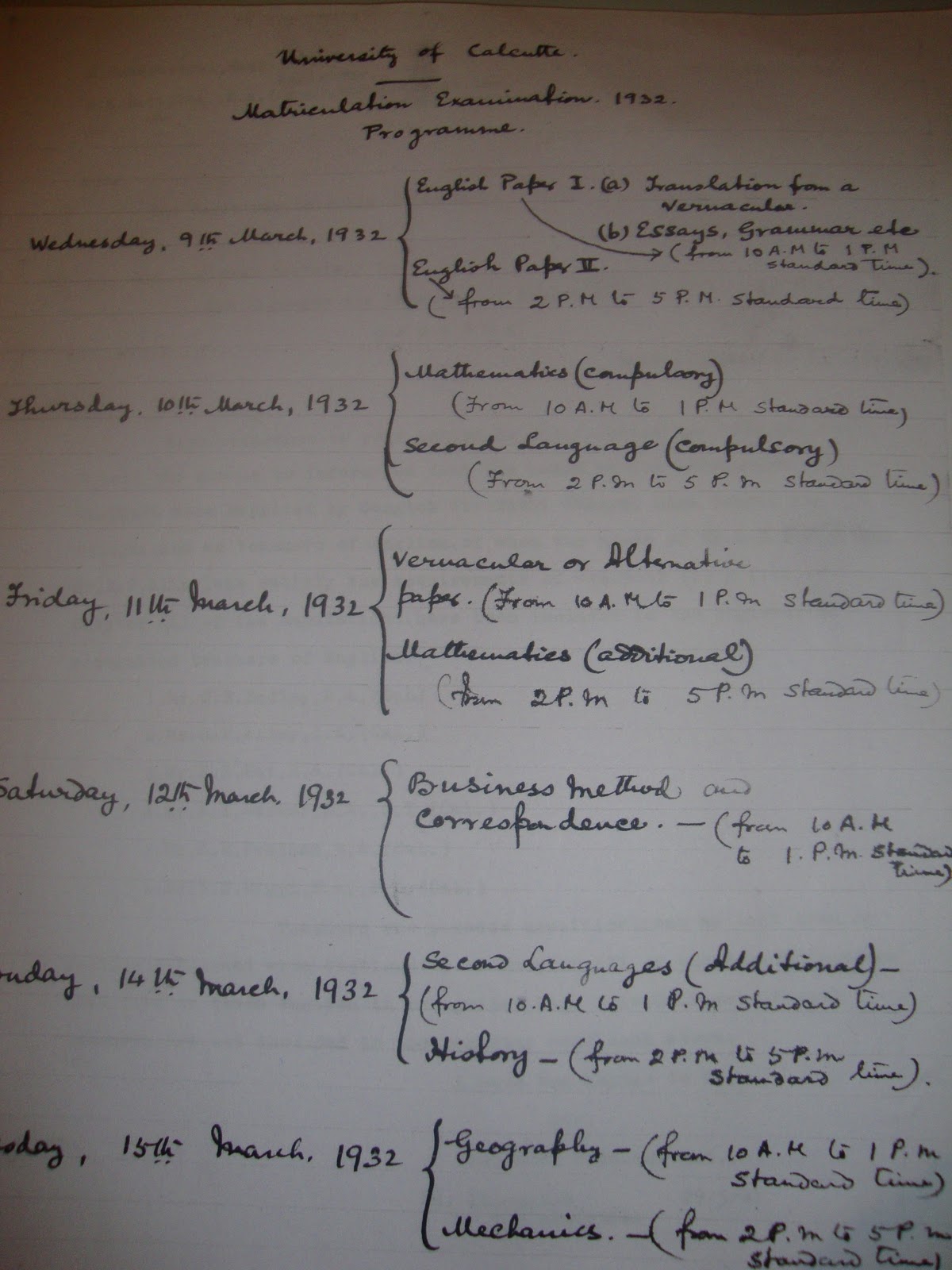
A hand written Hall Ticket of Calcutta University issued in 1932...


This hall ticket of Calcutta University is in all probability an oldest certificate as far as the education of Sikkim is concerned. Issued in 1932, the document has given detail information about the subjects that were taught at Calcutta University during the colonial era. The important feature of this hall ticket is that it is hand written. In that period, there were very few schools in Sikkim and most of them were providing education only up to the primary level. The first Government school of Gangtok was Gangtok School which was started in 1906, and this is where the late Maharaja of Sikkim, Sir Tashi Namgyal also studied as a first batch student. Later, the name of the Gangtok School was changed as Gangtok High School.
Before 1920, there were two Boarding Schools at Gangtok: The Bhutia Boarding School and The Nepali Boarding School. It was due to the diligent endeavor of late Rashmi Prasad Alley both the Schools were united which  later played a vital role for the foundation of first ever high school at Gangtok. The Gangtok High School was later named after the name of its first batch student and the then Maharaja of Sikkim Sir Tashi Namgyal. Though, with the efforts made by Lt. Rashmi Prasad Alley Gangtok got its first ever High school but, it was not an easy task for him to run it successfully. Due to the lack of higher institution in the proximity of the Kingdom, the only High School of Sikkim (Gangtok High School) was then affiliated to the Calcutta University.
 I am greatly indebted to Dr. Parshu Ram Poudyal Assistant Professor, Namchi Govt. College for sharing this valuable document with me. 

Sunakhari-The Pioneering Nepali Literary Journal of Sikkim...

Sunakhari is one of the pioneering Nepali literary journals of Sikkim. A contemporary of Kanchenjungha, the earliest news based journal of the previous Himalayan Kingdom of Sikkim, Sunakhari has played an imperative part for the endorsement of the literary ideas among the Sikkimese masses. The journal was started in 1957 by the earliest Nepali Literary Association of Sikkim, Apatan Sahitya Parishad, Gangtok. The picture pasted with this post is of Sunakhari which was published on the special eve of Bhanu Jayanti on 13th July 1958 (B.S 2015). Published by the very famous Apatan Sahitya Parishad, the front page of this issue is all about the introduction of Apatan Sahitya Parishad the first Nepali Literary Association of Sikkim. Published through typewriter, this issue of Sunakhari has given detail information about the various literary figures of then Sikkim with their portfolios in the Literary Association.
According to the report of this issue, the late Rai Saheb Hari Prasad Pradhan (M.A. L.L.B) was elected as the first President of the Apatan Sahitya Parishad. Further, through this issue of Sunakhari, the Apatan Sahitya Parishad has express gratitude to the eminent Nepali writers of Nepal like Bal Krishna Sama, Lakshmi Prasad Devkota, Mahananda Sapkota, Tara Chandra Sharma, Narayan Upadhyay, Shiva Kumar Rai (A Sikkimese by birth, latter settled in Darjeeling) and to Dev Kumari Sinha. The most interesting facet of the publication is that on every issue of Sunakhari the word Sikkim is written as Suk-kim.
(Picture Above Sunakhari  published on 13th July 1958 from Gangtok)

Talk of Mr. A. D. Moddie at Capital Hall Nainital...

In my earlier posts, I have published little information about Mr. A. D. Moddie who is a Historian, a gigantic stature in the Himalayan Studies, an IAS, a well-known figure in the corporate world, a thinker, a writer, a mountaineer and of course an adoring and a loving husband and a father. The most important thing about him is that he was the first Indian mountaineer who scaled Mt. Lama Aden in North Sikkim in the pre independence period. Further, Mr. Moodie had visited Gangtok in the late 50’s as a trading agent of Unilever Company and went up to Gyantze in Tibet via Nathu-La with a passport issued to him by the authorities from Pandra Mile in Sikkim. During his stay at Gangtok, he had been able to meet our Chogyal Sir Tashi Namgyal who according to him was a very pious person. I got an opportunity to be present at a talk by the most ascribed person that I have ever interacted, today at the Capital Hall, Nainital. The arrangements for the event were made by People’s Association for Himalaya Area Research also known as PAHAR, Nainital. The topic of his talk was ‘Opening of Himalayan Doors ‘Jewel in the Lotus’ to Geo-Politics’. The subject matter itself was an enthralling one for a student of history like me. I reached the venue nearly 15 minutes before the given time to interact to that old man of 90, who was going to have a discussion on the Himalayan Doors.
On his discussion, Mr. Moddie covered almost every sphere like the social, political and economic subject of the Himalayas. He focused on the aspect that the political boundaries are the brain child of the colonists and due to it the present Himalayan states are under pressure. They were having their own norms of governance and owing to the imposition of the laws gifted by the British they are agitating. In his talk of nearly two hours,  Mr. Moddie described the Himalayas in three different phases. “First, the early centuries of the jewel of Lotus, the second phase of Shangri-La and the last half century of turbulent geo-politics, and restless people in rapid transition to the uncertainties and chaos of modern times”.  
As Mr Moddie had to cover the entire Himalayas at a short time, he discussed about Sikkim in a brief. He said “the spirit of adventurous discovery also brought the early European natural scientists to the region to explore Nature’s secrets in Shangri-La. The most memorable Example was Dr. Hooker (A Botanist friend of Darwin) to discover Sikkim’s Rhododendron high hills in 1840’s”. Mr. Moddie further stated that Sikkim is a good instance of transition from kingdom to democratic development.

The important rationale of the event was to felicitate Mr. Moodie by the PAHAR along with various other distinguished personalities of Uttarakhand. The entire event was a mesmerizing one not only for me, but, for everyone who have their interest to explore the unseen and neglected spheres of the Himalayas. 


(Pic. Above Mr. Moddie delivering his lecture at Capital Hall, Nainital on 14th Nov.2010 , Pic. Below publication of PAHAR on his topic of Discussion)

First Helicopter at Gangtok....


"Orville Wright (1871-1948) and Wilbur Wright (1867-1912) requested a patent application for a "flying machine" nine months before their glorious flight in December 1903, which Orville Wright recorded in his diary. As part of the Wright Brothers' efficient practice of photographing every prototype and test of their various flying machines, they had swayed an attendant from a nearby lifesaving station to snap Orville Wright in full flight. The craft soared to an altitude of 10 feet, traveled 120 feet, and landed 12 seconds after takeoff. After making two longer flights that day, Orville and Wilbur Wright sent a telegram to their father, instructing him to "inform press."

Detached from all these developments in the West, Sikkim preferred to live a secluded life even after its contact with British India. The then society of the former Himalayan Kingdom had never imagined about such kind of “flying machine” which was by now witnessed by the contemporary West. At that time, our society was for ever and a day guided by the mythologies which do not put up with any judgment in today’s perception. The people had a great faith on their mythological stories written in their religious books which always lacks logic and scientific standards to get fit in the modern perspectives. Accordingly, they might have a conception that an enormous religious person or the creator only can fly and take a round of sky.

Such a social set-up of Sikkim was able to witness the huge “flying machine” nearly after five decades of its innovation by the Wright Brothers. This rare photograph is preserved by the Alley Family of Gangtok which was taken on the day when the unimaginable flying object landed at Palzor Stadium then known as Polo Ground. We do not have a clear idea about the event but, the huge crowd behind the helicopter suggests us that how curios were the Sikkimese commoners to see the “flying machine” in front of them. It arrived at Gangtok at such an age when just to see a vehicle was not less than a great fortune to a commoner. 


(On the picture Family of  Lt. Rashmi Prasad Alley of Gangtok at Palzor Stadium, behind them the first Helicopter at Gangtok.)

First Nepali literary meet of Sikkim...

The growth in the awareness about the Nepali literature in India was undoubtedly pioneered by the Nepalese of Darjeeling. People of that expanse got enlightened about their language and literature due to their propinquity to the British. Sikkim was thence in a nap which was a sleep of illiteracy and unawareness. Very few of the Sikkimese were educated on the eve of the First World War and who belonged to the Super class and were not engrossed to make their subordinates aware about their literatures nor did they themselves had written anything. They were simply cramped in their revenue making practice. In such a state of affairs, to imagine a literary society was not less than a hallucination in the Sikkimese scenario. When Chandrika (A Nepali Newspaper edited and published by the jewel of Indian Nepali Literature lt. Paras Mani Pradhan) was widely circulated in the contiguous of Darjeeling, there were hardly a small amount of people in Sikkim who could write their names in their language. Though, the establishment of educational institutes was taken place in the first decade of the 20th century, but they were unable to produce the literary minds with their out dated theological syllabus. It was only after the arrival of Lt. Rashmi Prasad Alley to Sikkim the system of imparting education in Nepali language was started. The vigorous attempts of Lt. Alley are unforgettable and would be considered the same by every Sikkimese ceaselessly.
The credit for the prologue of the Nepali language in the Sikkimese schools goes to the then Maharaja Tashi Namgyal who allowed to approve Nepali as a language for the idea of giving out education to his Nepali subjects. With the introduction of Nepali as a vernacular language in the educational institutes, Sikkim had contributed lots in the Nepali Literary world. Many radical and rational writers were born in Sikkim among them the writers of the APATAN literary society are of importance. The Apatan Sahitya Parishad is the pioneer literary association of Sikkim founded by four eminent Sikkimese Nepali poets namely Agam Singh Tamang, Padam Singh Subba, Tulshi Bahadur Chettri and Nima Wangdi Lepcha. They had a cry in their writings a legitimate cry against the crooked practices customary in the society like landlordism and its associated vices.
Under the inventiveness of the APATAN literary society, the first literary meet was organized at White Hall Gangtok on 18th and 19th of November 1952. The important literary figures who were present in that meet were Kavi Siromani Lekh Nath Poudyal, Lt. Rashmi Prasad Alley, Bal Krishna Sama, Padam Singh Subba Apatan, Tulshi Bahadur Chettri Apatan, Lt. Kashi Raj Pradhan and among them the figure of great importance was Mahakavi Lakshmi Prasad Devkota. The conclusion of the first literary meet had a far reaching impact in the Sikkimese literature in general and the Nepali literature in particular. The essential accomplishment of the meet was the publication of the first news based journal of Sikkim Kanchanjunga from 15th of August 1957. The Newspaper was edited and published by Lt. Kashi Raj Pradhan which had played an imperative ingredient in heralding a new epoch of democracy in Sikkim. 

(In the picture tall man in suit is Rashmi Prasad Alley, left to him in black suit is Kavi Tulshi Bahadur Chettri Apatan, Right to Alley is Bal Krishna Sama, next to Sama tall man in Nepali attire is Padam Singh Subba Apatan, the last man on the row in a black coat is Kavi Siromani Lekh Nath Poudyal)
Muna Madan: A Play in the Jhyaure Folk Tradition

Mahakavi Laxmi Prasad Devkota at Gangtok.....


Lakshmi Prasad Devkota is regarded as the propounding father of romanticism in the Nepali literature. Devkota was deeply influenced by the writings of William Wordsworth, P.B. Shelley, Byron and John Keats. He is the pioneer of modernity or modernism in Nepali literature, especially in essays and poetry, and he is also regarded as 'Anshu Kavi'(spontaneous poet). He could write poems in a spontaneous manner and even while signing autographs for his fans, he used to write a poem before putting his signature. Devkota’s poetry depicts the romantic characteristics like humanism, metaphysical relationships, aesthetic values, past glories, praise of nature etc. Apart from romantic writings, he wrote some potent revolutionary poems possibly under the impact of P.B.Shelley.


The  masterpiece which renders him the loftiest position in Nepali Literature is his 'Muna-Madan'  in which he tried to depict the deplorable economic condition of Nepal in the most celebrated characters of two youths  Muna- a Nepali village girl and Madan- a Nepali peasant. The short epic can be compared to 'Romeo and Juliet' of William Shakespeare in the context of love and emotion 'Muna-Madan' is written in Jhyaurey prosody, the typical Nepali folk lore. This work of Devkota has been translated into several languages like German, French, English, Russian, Hindi, Japanese, Chinese etc. and it has gained same popularity as it gained in the Nepali literary world. 


The glorious Nepali poet had once visited the Demasong Valley. He was invited here by the APATAN Sahitya Parishad in November 1952. The Apatan Sahitya Parishad is the pioneer literary association of Sikkim founded by four eminent Sikkimese Nepali poets namely Agam Singh Tamang, Padam Singh Subba, Tulshi Bahadur Chettri and Nima Wangdi Lepcha. This Association has contributed a lot for the propagation of literary ideas among the Sikkimese society. He was felicitated at White Hall, Gangtok on November 15th 1952, where Lt. Kashi Raj Pradhan made an introductory speech about Devkota and Padam Singh Subba read the Letter of Appreciation, which was presented to him. The then Sikkim Maharaja Tashi Namgyal roared in laughter when Devkota recited an English poem in Vedic prosody. His Majesty, the Maharaja of Sikkim Sir Tashi Namgyal was splendidly hailed by Mahakavi Lakshmi Prasad Devkota in a poem which reads like the following:


Hail! Glorious ruler of this mount in state, 


Sikkim, the paradise of peaceful peaceful hills,


This lively sweet abode of angels, great,


Great in thy name. Thy well known bounty fills


With plenty of thy kingdom. Stainless soul,


Deeply devoted to the God that thrills


Thy inmost depth, thou findest him all whole


Thy own angelic subjects in their wills


Amassed forever in love to their great good


Selflessly hast thou lived, the Buddha life


In thy keen veins where human love must brood 


And multiply, rich and intense to thrive


Thy teeming millions to whom a holy shire


Thou dost with sense of human sacrifice aye in spire.


(The tall man in a coat in the middle of the row is Lt. Rashmi Prasad Alley, to his right Mahakavi Lakshmi Prasad Devkota, Right to Devkota is Padam Singh Subba of  'Apatan' literary association of Sikkim, to the left side of Alley, is Bal Krishna Sama a legendary figure of Nepali Language. The picture was taken at the palace corridor Gangtok in November 1952)

The pioneer of Nepali Education in Sikkim.....Rashmi Prasad Alley

Rashmi Prasad Alley was born in 1898 at a place called Gwalpara in Assam. He was a writer, a devoted teacher and a great devotee of the Nepali language. Lt. Alley was the first person to introduce the system of imparting education in Nepali language in Sikkim. He came to Sikkim in 1920 when the country was at the core of illiteracy, poverty and was crammed with the ignorant oppressed masses. There was no stipulation of giving out education in Nepali language in Sikkim when Lt. Alley came to Gangtok in 1920. He insisted the Royal Government to make a provision to convey education in the widespread language of the Sikkim Subjects. But, none of the authority paid any concentration to the ideas made by him. Aggravated from the Government’s retort he himself started to teach his students in their local tongue on every Saturday and Sunday at his own residence. After his meticulous attempt the Nepali language got its recognition among the masses which greatly helped for the expansion of the Nepali literature in Sikkim. 


Lt. Alley got his basic education in Bangla medium in Assam and taking Assamese as his key subject, he accomplished his High School in 1913. He did his Plus Two (then known as I.A) from Cotton College Guwahati. In 1919 he came to Darjeeling and worked for Chandrika (a Nepali News Paper Edited by Lt. Paras Mani Pradhan). It was in 1920; Lt. Alley got his appointment as a Head Master at Gangtok Boarding School. There were two Boarding Schools at Gangtok: The Bhutia Boarding School and The Nepali Boarding School. It was due to his diligent endeavor he was able to unite both the Schools and also played a vital role for the foundation of first ever high school at Gangtok. He worked as a teacher till 1941 at the Gangtok High School and during this period the system of dispensing education among the Nepali students started in Sikkim.
Apart from a teacher Lt. Alley was a great philanthropist who along with Raghu Bir Singh Basnett founded Dukha Niwarak Samity for the destitute. Lt. Alley was appointed as the Forest Minister in the ‘Popular Ministry’ of 1949. But, due to some circumstances the said Ministry was dissolved within 29 days of its formation.

(The photograph was taken in front of Gangtok Boarding School in 1930, Lt. Rashmi Prasad Alley can be seen in the middle row)


Old Pictures......

Chak Tha Rimponche.....A fact or an anecdote?


The history of Sikkim is always surrounded with the folklore, mysteries and fictions. It is covered by a thick blanket of legend and mythology in which one can find births, re births and incarnations and much mythological bits and pieces which in fact have no credibility in history. But, even being mythological in nature they cannot be ignored entirely as they have their roots in our times of yore. The photograph pasted here belongs to a person who was then known as Chak- Tha Rimponche, who according to the people of Tashiding West Sikkim, used to be a conventional Buddhist. Chak Tha was a Bhutia by caste who hailed from Tashiding (Gangyap), West Sikkim and a Lama by profession. But, according to the few natives of Tashiding, at a distance from his occupation he used to tame cattle in the forest of Pokhri- Dara and its neighboring area. The descendents of those cattle tamers believe that Chak Tha had some paranormal power by which he could even control the nature. It was due to his clairvoyant smack he could fly like a bird which (according to the belief of the local people) could prove a great calamity for them. Therefore, to avoid such disaster Chak Tha was kept like a captive by his village men and Lamas by tying him with an iron chain which weighed more than a quintal.  Due to the lack of evidences it is not possible to ascertain his definite period. But, when we stumble upon with the photograph of the Rimponche it becomes clear for us to understand that he certainly lived in Sikkim after the latter’s contact with British India. Because, before the advent of the British, camera, photographs and sketches were dreamlike things to the Sikkimese society.  
The account of Chak- Tha greatly allured me in the beginning but, when I heard the whole narrative I found it to be larger-than-life. The half naked body along with some other unknown object proves that he was a great Tantric Lama who certainly was the follower of Tibetan Tantricism. The Dammaru in front of him (right hand side), his hair-style, and a Trisul kind of entity on his left hand makes it clear that Chak- Tha was a great Tantric Lama who in all probability exhibited his acquaintance in front of the villagers and those acts of the Rimpoche later became the legends in the village and transferred from one generation to another. But, apart from all other issues, it is a fact that Chak Tha was a native of Tashiding (Gangyap) and his family still lives at the very same place where he had his eminence.
The picture was possibly taken by some British officials on their way to the famous Tashiding monastery.

Trade between India and Tibet in the Colonial Period


Nathu-La has played a noteworthy role for the endorsement of British trade in the colonial era. It not only served as an access to Tibet for the British merchandise but from this very doorway the British haNathu-La has played a noteworthy role for the endorsement of British trade in the colonial era. It not only served as an access to Tibet for the British merchandise but from this very doorway the British had been able to set up an amiable relation with the sleeping giant i.e. China. The picture shows how trade and communication were undertaken by both the parties. The chief means of transportation (as shown in the picture) in those days was of the mules. We can clearly notice the condition of roads probably constructed by the British Government for their trade and commerce in the far flung land of Tibet. It is to be mention here that, after having their upper hand in the administration of Sikkim, they started to construct the roads and bridges from the Himalayan Kingdom which connected British India with Tibet. Even I was told by Mr. A.D. Moddie that, before the triumph of Communist China over Tibet, the similar trading features were prevalent between the two countries. Regarding the transportation system that was available in Sikkim in 1957 he writes:-


“…As there were only two ways, a trader’s or a pilgrim’s permit, I opted for the former. I wrote to our agent in Gangtok, Sikkim, to arrange a mule and a muleteer for me; I would walk. When I arrived in Gangtok and enquired about the mule arrangement, the Agent prevaricated. He shyly disclosed he had arranged twenty mules. He was taking advantage of a sahib-type, who also knew the Political Officer, Gangtok, to send his mules train in, for greater security, under my leadership. When I met Apa Pant, the P.O. for my permit in English, Hindi and Tibetan, I thought I would amuse him with the story of one mule becoming twenty. Apa Pant saw no humor in it. In serious official style, he advised me to take all twenty mules saying, “One mule no status, twenty mules status”.
The writings of Moddie are justified by the documentation preserved by Das Studio Darjeeling. It probably is the only document potted in India associated with Tibetan trade. We are grateful to the proprietors of Das Studio for preserving the antiques which are so prized to peep inside our past.

Second Letter of Mrs. Indira Gandhi to Mr. K.B. Adhikari of Rhenock...

This letter is also sent to Mr. K.B. Adhikari of Rhenock by the then Prime Minister of India Mrs. Indira Gandhi. I am again obliged to Mr. Deepak Bhandari Sharma of Rhenock for sharing this implausible document with me. The correspondence is a response from the Prime Minister to Mr. Adhikari about the invitation made by the latter on his son’s wedding. In the letter dated 17th February 1979, Mrs. Gandhi has congratulated the folks of Mr. Adhikari and conveyed her best wishes to the newly wedded couple. But, due to the negligence made by the person with whom this document was conserved, the signature made by the Indian Prime Minister is not properly detectable.


Kanchenjunga....The First Nepali News based journal of Sikkim.


Sikkim, on the eve of Indian independence, was a closed book as far as the political activities were concerned. Few movements were taking place in some far-flung places of Sikkim but, they did not have much impact on the political enlargement of the country. They can be considered as an act of waywardness by the peasants against their feudal lords and those acts were flattened down with iron hands. This all was happening due to the political oblivion among the subjects of Sikkim. They had an intimidation in their minds, an intimidation of confiscation of their private property therefore; they could not raise their voices against the atrocities imposed upon them by their Masters (Kazis).  There was no question of education in such a situation where one loaf of bread was dearer then the philosophy of Marx, Engel, Gandhi and Socrates.  
For the establishment of an egalitarian government, journalism has always played an essential role. Journal not only provides information about the fresh developments but also provides broader sphere for arousing the feeling of liberty, parity and democracy among the browbeaten and mistreated section of a society. Before the birth of ‘Kanchenjunga’ there were very few journals like Amulya-Ratna (hand written journal) published in 1948 and 'Pushpanjali' of the APATAN literary society and The Pole-Star published in 1951 by Mahananda Poudyal were in the scenario but, they were not able to reach at the doorsteps of the ill-treated section as they focused mostly on the literature feature, ignoring the political aspects. To fill-up the inadequacy in the political process of Sikkim the publication of a monthly Nepali journal ‘Kanchenjunga’ was started on 15th August 1957. The editor of this journal was Nahakul Pradhan but, the entire important workout for the publication of 'Kanchenjunga' was completed by Mr. Kashiraj Pradhan. It is to be noted here that 'Kanchenjunga' was the first news based journal of Sikkim written in the language of the majority i.e. Nepali.
I am greatly indebted to Miss Pabitra Bhandari for sharing with me the aged page of the ‘Kanchenjunga’ which seems to be the 26th issue of the journal. Published on 15th September 1959, it provides us information about the asylum of the Dalai Lama of Tibet at Mussouri in India.  It is stated further in the journal that the Gyawa Karmapa had taken his refuge at Rumtek monastery, nearby Gangtok, along with his 80 followers. A refugee Committee was formed on the chairmanship of the eldest princess of Sikkim Pema Choden to take care of the Tibetan refugees. According to the reports of Kanchenjunga of 15th August 1957, three to four thousand refugees were to be permitted to come to Sikkim to work as the labourers for the construction of roads under Public Works Department, Government of Sikkim. The first group of such refugees which comprised 271 Tibetans had already reached Sikkim and was executing its duty as the labourers in North Sikkim.
Probably, this is only the piece of information related with the Tibetan refugees in Sikkim which is obtainable from our state. 

Letter of Mrs. Indira Gandhi to Mr. K. B Adhikari of Rhenock...

I am greatly thankful to Mr. Deepak Bhandari Sharma of Rhenock, East Sikkim for sharing this valueable piece of information with me. The letter pasted here has been sent to Mr. K. B Adhikari of Rhenock by the Late Prime Minister of India Mrs. Indira Gandhi. It is to be noted here that, with the accession of Sikkim into India there was still  resentment among the Sikkimese people against the Indian Government for having been cheated by the authorities during the referendum process. Therefore, they were opposing Indian overlord ship upon them and were against the visits of the Indian leaders to Sikkim.
The letter dated 19th September' 1978, reflects how the Indian Tri-Colour was insulted unknowingly, as it was put up-side down, by few "miscreants"  during the visit of Mrs. Indira  Gandhi. In the letter Mrs. Gandhi has defined the act as a "deliberate". It was Mr. K. B. Adhikari a Mandal of Rhenock and an important figure of the democratic movement of Sikkim, who informed the authorities to keep the flag in the order. With the steps taken by Mr. Adhikari, a  national insult was averted in Sikkim.

Wake-Up Dude....!!!


This again is an evidence of our indifference towards our traditional riches. The captions added below the photograph suggest that it is a Sikkimese monastery. From the outer looks, it can be conjectured that this is the monastery of Tashiding. It seems that a religious rite is captured by the photographer who was really serious about preserving these valuable moments. We need to pay our sincere courtesy to the Das Studio, Darjeeling for collecting and conserving the rare sight. On the contrary, we may put the so called aristocratic rulers of the then Sikkim into the hot suit for being so indulgent in their materialistic perspectives and thus ignoring the interest of the greater institution. This is a serious point of discussion--- if the photograph could be procured by a studio of Darjeeling, why could the same not be done by the much acclaimed Sikkimese nationalists? Once again, we come to the observation that either they were too conservative to share those belongings with mass people or they did not really think about the importance of the same because they were well accomplished in their realms of wealth and power.