Showing posts with label Maharaja Tashi Namgyal. Show all posts

Paljor Namgyal- The Pilot Prince of Sikkim


Prince Paljor Namgyal, the first and the only Pilot prince of Sikkim was born on 26thNovember, 1921 at the Royal Palace, Gangtok to the Eleventh Maharaja of Sikkim, Sir Tashi Namgyal, K.C.I.E, K.C.S.I. and Maharani Kunzang Dechen. His original name was Kunzang Choley and he was the eldest son of the Eleventh Royal Couple of Sikkim. In 1930, he was sent along with his younger brother, Prince Palden Thondup Namgyal and their sister Princess Pema Tsedeun to St. Joseph’s Convent, Kalimpong. Prince Palzor Namgyal was further educated at St. Paul’s School, Darjeeling and St. Joseph’s College, Darjeeling.
The Crown Prince, Paljor Namgyal was commissioned as a Pilot Officer in the Royal Indian Air Force and based at Ambala. He served in World War II in 1940-41. As a true ally of the British Indian Government, Sikkim had greatly served in providing manpower in the said world war. It is to be noted here that many Sikkimese family had also send their children to fight against the English foes and few of them had been able to receive the esteemed Victoria Cross. But, most wretchedly, Paljor Namgyal was killed in active service after he crash landed in flight near Peshawar, on 20thDecember, 1941. He was merely 20 years old then. Regarding the death of the Crown Prince of Sikkim the Bharat Rakshak an official website of Indian Air Force has published this information “On 8th December, war was declared with Japan and the Squadron was ordered to the Burma front on 14th December. The Squadron returned to Peshawar two days later.  As there was a shortage of air gunners, volunteers were called from among the fitters, riggers and other ground crew members. The airmen volunteered almost to a man. They were trained on a fast track basis in less than a fortnight. The Squadron suffered its first casualty on the Lysander on 20th December 1941, when Pilot Officer Paljor Namgyal, who at that time was the crown prince of the Kingdom of Sikkim, undershot trying to land at Peshawar. The aircraft R1989 hit a bund and overturned - killing the pilot and seriously wounding the observer”.
The tragic death of the Sikkimese Prince has also been mentioned by PVS Jagan Mohan in his book ‘The Westland Lysander in Indian Air force Service’ in the following manner “The squadron suffered its first casualty on the Lysander on 20th December 1941, when Pilot Officer C Dhairyam, with Pilot Officer Paljor Namgyal as his passenger undershoot trying to land at Peshawar. The Air craft R1989 hit a bund and overturned - killing the pilot and seriously wounding the pilot. Palzor Namgyal was the Crown Prince of Sikkim and his death was a major blow to the people of the small Himalayan Kingdom(P14).
As an Air Pilot Prince Paljor Pic: http://sikhim.blogspot.com
Most unfortunately, we have very little credentials about the pilot prince Paljor Namgyal. Few photographs that include his portrait in the Air force uniform are the only source to write something about him. During my fieldwork, I have been able to get a bit of unwritten information about the late Crown Prince of Sikkim. Few old Sikkimese, especially those who have seen him during their lifetime, have an immense respect and love for Paljor Namgyal. An old person Mr. Harka Bahadur Subba of Chota Singtam along with few old people has informed me that the Prince was a placid and a kind person. Once while hunting Prince Paljor reached to a house of an old Lepcha lady at Nandok in East Sikkim. She was unaware about his gigantic position and she offered Dhero (meal prepared from millet mostly consumed by the poor peasants during feudalistic Sikkim) to him for his dinner. He inquired about the poverty of the old lady and came to know about the forceful collection of Dhurikhajana and the prevalence of Kalobhari, Jharlangi and Theki bethi as forced labor. After spending a night at the home of the old lady the prince recoiled to his palace and informed his father Maharaja Tashi Namgyal about the utter poverty of their subjects and insisted him for the immediate removal of the forced labour and Dhurikhajana. Before the king could do anything in this regard, the Kazis and other feudal elements misguided the king to send his eldest son to join the Royal Air Force and was finally killed in an air crash.
Photo Frederick Williamson Prince Paljor Namgyal standing in front of C. E Dudley Pic: Digital Himalayas

Maharajkumar jyudo hunuhunthyo bhaney ta Sikkim aarkai hunthyo had the Maharajkumar been alive Sikkim could have been different” was their remark on the untimed demise of the late crown prince Paljor Namgyal.

Sikkim Almanac: A Monarchical Souvenir to the State of Sikkim


Sikkim Almanac
Every Sikkimese has seen Sikkim Almanac hanging on the walls of every Official building or in every house to get an idea about the official government sanctioned holidays for a particular year. But, we have never paid any attention to understand its link with the past of Sikkim. The Sikkim Almanac nowadays is merely serving as an everyday planner of the Sikkimese people. But, distant from being the official holiday marker the Sikkim Almanac has its profound bond with the history of the erstwhile Himalayan Kingdom of Sikkim.
The Royal Government of Sikkim began to issue its Almanac, which lists the official government sanctioned holidays for each year, in the mid 50’s of the last century. The noble task was undertaken during the glorious reign of Maharaja Sir Tashi Namgyal. The sole purpose of issuing such Government Calendar was to inform the subjects of the Maharaja about the Government sanctioned holidays in the kingdom of Sikkim, so that they could avoid themselves from reaching the Capital during holidays for their Official works. The Government sanctioned holidays in the calendar were highlighted with red colour which was easier for every individual to get an idea of the existing holiday in a particular month. The very same layout of Almanac is still prevalent in the Sikkim Almanac issued by the Government of Sikkim.
The Sikkim Almanac has some distinctive features as well. In conjunction with the dates of Gregorian calendar in English are the dates of Tibetan Lunar Calendar in Tibetan scripts. Presently, the heading carries emblem of Sikkim Government but, during independent Sikkim it used to have a portrait of the reigning king of the Kingdom. The fifties (1950’s) version of the Sikkim Almanac carried pictures of Maharaja Sir Tashi Namgyal in full Royal ceremonial dress, while the pictures of Chogyal Palden Thondup Namgyal were more casuals. The placing of the King’s pictures on Sikkim Almanac was stopped after Sikkim’s integration with the Indian Union. Apart from English and Tibetan languages the title of the Almanac is also written in other Sikkimese languages like Lepcha, Nepali and Limbu which is in vogue since its first issue.
Either side of the Almanac is bordered by the Eight Lucky Signs known as Tashi Tagey (Tak Gye) in Tibetan. These auspicious signs are symbolic with the life and teachings of the enlightened Tathagatha. After Sikkim’s integration with India, the Sikkim Almanac is printed and distributed by Home Department, Government of Sikkim every year.

A Handwritten Sikkim Herald- The oldest Surviving Newspaper of Sikkim


The publication of Sikkim Herald was started in 1956 during the reign of Maharaja Sir Tashi Namgyal to inform his subjects about the developments brought about by the Government. The initial format of Sikkim Herald was a magazine and it used to get publish every months. Prior to 1962, the Sikkim Herald Magazine was brought out in English only and later sometime in 1962, editions were brought out in Bhutia and Nepali languages as well.
The Handwritten Sikkim Herald in Nepali preserved at Ramgauri Sangrahalaya 
The picture with today’s post is also of this oldest newspaper of Sikkim in Nepali Language. The remarkable attribute of this publication of 1967 (6th Year Issue 21) is that it is a handwritten newspaper which was published on Thursday 16th February 1967. It is possibly a first of its kind in the history of journalism in Sikkim. The Top Headline of this issue deals with the suspension of the Sikkim Executive Council in the said year. It states “As per the Government Report published by the Chief Secretary Government of Sikkim Mr. T.S Gyaltsen, the Maharaja has unleashed the Councillors from their posts on 15th of February 1967 as they were busy in campaigning for the forthcoming election. Henceforth, the subjects are informed that their applications related to various concerns are to be sent to the concerned Head of the Departments for necessary action”.
The Second Headline of the Newspaper deals with the resistance techniques to be adopted to protect an individual from “Mai” influenza. The Herald has informed about the suspension of classes from all the schools for 15 days surrounding Gangtok to prevent from its further transmission. Further, this handwritten issue of Sikkim Herald has also informed the public about the date and venue as well as necessary requirements to sit for the written examination of a stipend for the year 1966-67, granted to the Sikkimese Students by the Government of India.
The Last News is an obituary on the demise of Mukhtiyar Palden Dorjee. The Sikkim Herald is now a daily publication brought out by the Information and Public Relations Department (IPR), Government of Sikkim, containing news and information on the developments and the programmes of the Government as well as notices regarding tenders and other important government notifications. One can find Sikkim herald in all the major languages spoken in Sikkim like Bhutia, Lepcha, Nepali, English and Limboo.
The only piece of this Handwritten Sikkim Herald is preserved by Shree Ganesh Pradhan of Ramgauri Museum Rhenock East Sikkim. I am greatly indebted to him for sharing this priceless document with me.

Feudal Judicial System of Sikkim- A Brief Review


Like any other feudalistic arrangements, the judicial system of Sikkim has a history of its own. The King though, enjoyed a highest position in the feudalistic set up, could not execute his judicial obligations properly as he was surrounded by the then “Elites”, the Kazis, who were the de-facto arbitrators of their Ellakas. They could tax, confiscate, mortgage and sometimes seized the lands of peasants into Home Farm, the Private land holdings of the Kazis.   In short, the Kazis were the fountainhead of justice in feudalistic Sikkim and it is because of such “Lawless Law” the ordinary peasants were compelled live a combatant’s life.
Sikkim’s contacts with the British Indian Government had even worsened the existing judicial system of Sikkim. Available testimonials highlight that in 1909, the Kazis, Thikadars and Lamas were invested with legal powers by a State Council Resolution. They could try Civil Suits up to the valuation of Rs. 500/-. The State Council Resolution of 1909 had thus given an overwhelming power to the state machinery (Kazis, Mandals, Mukhtiyars, Karbaris) to exploit the common people, especially the peasants in the name of legal action. It is to be mentioned here that the formation of “British Styled” State Council used to have the British Political Officer as its President. After the establishment of the said Council, the Sikkimese Kings were kept behind curtail and the British Political Officer began to take decisions, enact Laws and to rule the Kingdom with the assistance of pro-British Kazis like Phodang Lama, Khangsa Dewan and Shoe Dewan and so on. The Kings whosoever tried to oppose the new set up either were sent to prison (Maharaja Thotub Namgyal) or were given mysterious death (Maharaja Sridkyong Trulku). Before the establishment of High Court at Gangtok, administration of justice in Sikkim was being carried out by the Feudal Landlords (Adda Courts), Dzongpens (District Officers). Pipons (Headmen) and Mandals with the Chogyal at the top.  All the important judgments were given at the Adda Courts and at the Settlement Houses by the Feudal Officials and used to give inhuman punishments of Thinguro placed at the Kazi’s House. These Thinguros were made up of wooden planks, the culprit had to put his legs inside the hole of the Thinguro, after doing it, the mouth of the Thinguro was tighten by a rod or an iron, thus, leaving the culprit standing with utter pain. He could not sit as the wood was tightened on his knees, therefore he did not have other alternatives than to cry in the dark prison of the Kazi. Further, he was not given a single drop of water for three four days, after the Kazi got satisfied from the punishment, finally he was granted pardon.
In 1916, Appellate Courts by the designation of Chief Court was created with jurisdiction to try important original suits and also to hear appeals against the decisions of the Adda Courts. But, from the study it reveals that there were very few cases of appealing against the decision of the Adda Courts due to the threat of havoc from the Kazis and Mukhtiyars. This Court also exercised supervisory and appellate jurisdiction over the Adda Courts. The Chief Court was not the final Court. The appeal against the decision of the Chief Court would lie to the Supreme Court of His Highness, the Maharaja. The Court of the Maharaja was the final Court of appeal in the State. It has no original jurisdiction. A Board on the lines of the Judicial Committee of the Privy Council in England would hear the parties and scrutinize the evidence regarding merit of the case and then tender its opinion to the Maharaja. (From the compilation of Hon’ble Shree A.P Subba, Former Judge High Court of Sikkim)
 In 1949, the Adda Courts were abolished on the recommendation of the Judicial Proposal Committee. The State was divided into 4 (four) revenue Districts and Magistrates were appointed in District with original and appellate jurisdiction on the criminal and civil side. The Courts of the Assistant Magistrate and the Court of Tahsildars were created. In the lowest rung, a few Honorary Courts of Magistrates were created to dispose of petty criminal and civil cases. The Chief Magistrate had both original and appellate jurisdiction on civil and criminal sides. He had unlimited powers (From the compilation of Hon’ble Shree A.P Subba, Former Judge High Court of Sikkim). 
The independence of India breeds a new hope of liberty inside the minds of the peasants of Sikkim. They too began to organise themselves in a larger manner for their rights and liberties. Due to pressure made by Sikkim State Congress, all the forced labours were wiped out by the reformist Maharaja Sir Tashi Namgyal in 1948. Further, the overwhelming powers enjoyed by the Kazis and his Officials were also restrained, indicating a new aeon in the history of Judiciary of Sikkim. From the available records it appears that in 1953, a Judge of the High Court of Sikkim was appointed but in 1955, High Court of Judicature (Jurisdiction and Powers) Proclamation, 1955 was issued establishing a High Court in Sikkim. The High Court thus established was made the final Court in all judicial matters, civil or criminal, subject to the exercise of prerogative by the Maharaja to grant mercy, pardon, remission, commutation and reduction of sentence in case of conviction. The Maharaja had also retained his prerogative to set up a Special Tribunal for the review of any case, civil or criminal. 
After becoming the 22nd State of India under Clause (i) of Article 371F, the High Court functioning immediately prior to the date of merger became the High Court for the State of Sikkim under the Constitution like any other High Court in the country. Under Clause (i) of the same Article all Courts of Civil, Criminal and Revenue Jurisdiction, all Authorities and all Officers, Judicial, Executive and Ministerial throughout Sikkim were to continue to exercise their respective powers subject to the provisions of the Constitution and under Clause (k) all laws in force immediately before the appointed day in Sikkim were to continue to be in force until amended or repealed by a competent legislature or other competent authority. 

Sikkim Jewels: A Legacy of Royal Government of Sikkim Shuts Down


Pic: Sikkim Now

Sikkim Jewels Ltd. Was established in 1972 during the reign of its last Chogyal Palden Thondup Namgyal. The foremost intention of establishing such industry by the Royal Government of Sikkim was to cater to the demand of Watch Jewels and Cup Jewels. The Company had started with a very small capacity of producing 2.00 Lakhs of Cup Jewels and 1.50 Lakhs of Watch Jewels per month. It was established at Tadong Gangtok and is spread over 3.23 acres of land. Sikkim Jewels Ltd used to be the second oldest Company of the erstwhile Kingdom of Sikkim. The oldest of such Companies is Food Preservation Factory at Singtam established in 1956, during the reign of Maharaja Sir Tashi Namgyal, the reformist. The Company had strengthened its position in the market for Watch Jewels, Cup Jewels and Rotor Magnets. In all these products, it had obtained sizeable orders from all the leading manufacturers of India like Hindustan Machine Tools Ltd., Titan Industries Ltd., and Allwyn Watches Ltd., Jaipur Meters and Electricals Ltd., VXL India Ltd., and Andhra Pradesh Electricals and Equipment Corporation.
There was heavy recession in domestic market in all the three major items produced by Sikkim Jewels Ltd. Hence, the factory was running under its own capacity since 1997. Only in 2000-2001, the unit had been able to increase its production after receiving substantial orders from both domestic and international market. The unit produced a record of 30 Lakhs Watch Jewels in November 2000. Amid to its increase in production, the current world wide economic depression has compelled Sikkim Jewels Ltd. for an untimed demise.
The Daily Telegraph of March 11 2011 reports:
The Sikkim government has decided to wind up Sikkim Time Corporation, Sikkim Jewels Limited and Sikkim Precision Industries Ltd after attempts to revive the three loss-making public sector undertakings through private participation failed....... State commerce and industries secretary M.G. Kiran said the decision to shut down the three PSUs had been taken by the cabinet on March 2.

Pandit Nehru’s 24 hours visit to Sikkim on 28th December 1957


Pandit Jawaharlal Nehru, the first Prime Minister of Independent India also known as Chacha Nehru had a great admiration with the erstwhile Himalayan Kingdom of Sikkim.  During his tenure as the Prime Minister of India he has visited the tiny Himalayan Kingdom of Sikkim and had received approbation from its subjects. As per the report of Kanchenjunga, the first news based Nepali journal of Sikkim, the late Indian Prime Minister reached Rangpo, a bordering town (that bordered Sikkim with India) in the morning of 28th December 1957 on his way to Gangtok, the Capital of Kingdom of Sikkim. He was warmly welcomed by then Maharaja Sir Tashi Namgyal, the heir apparent Palden Thondup Namgyal, Nari K. Rustamji the Indian Dewan and the Executive Councillors of Sikkim Assembly. The journal further informs that the Indian Prime Minister was greatly welcomed by the people of Rangpo. “A crowd, busy in watching football match get into the town after hearing his arrival to wave their hands to the Prime Minister” the journal reports.  After the grand welcome at Rangpo Dak Bunglow, Pandit Nehru inspected the working at Rangpo copper Mining. He further insisted for the creation of own Indian machines for the development of such mines in Sikkim. After his brief visit to Rangpo Copper Mining the Indian Prime Minister visited Singtam Bazar and acknowledged the greetings made by the people of Singtam at School Phatak. At Singtam, he visited food preservation factory, constructed under the Seven Years Plan adopted by the Royal Government of Sikkim.
Indian Prime Minister Nehru at Palzor Namgyal Girls School 
He was also warmly welcomed by the people at 32 NO Ghattey School (now Brihaspati Parsai Sr. Sec School) Ranipool Golai, Deorali and Gangtok Bazar. The jeeps accompanying the Indian Prime Minister made several rounds of the capital clamouring the slogan of Panchseel Zindabaad.  On the same day, the Indian Prime Minister also visited Technical Institute, Tashiling Secretariat and STNM hospital and made a round of the Capital Town. In the evening, Pandit Nehru attended Garden Tea Party at Sikkim Palace hosted by the King Shree Panch Maharajadhiraj Sir Tashi Namgyal.
The report of Nehru's Visit to Sikkim published in Kanchenjunga 
The Report of Pt. Nehru’s visit was published in Kanchenjunga, (Vol.5 year 1957) the first News based journal of Sikkim. A copy of this journal is preserved by Shree Ganesh Kumar Pradhan of Rhenock at his private museum Ramgauri Sangrahalaya Rhenock East Sikkim)

Letter of Namchi Kazi to Sikkim Durbar 1937


Education has always played a vital role for the political development of a country. But, in the erstwhile Sikkim it was a privilege enjoyed only by the super class. People belonging to the grass root level did not have any opportunity to attend a school. In every society, people began to dream for a better life only after getting closer to education.  Hence, it plays an active role in grooming the ideas of democracy inside the ignorant and slumbered minds of the common people. Possibly, the neglected education system of the erstwhile Himalayan Kingdom was highly responsible for the delay of democratic ideas among the Sikkimese peasants.
Above all, the majority of Sikkim’s population was that of peasants or ‘Bustiwallas,’ as they were known by the authorities that time, were very much innocent. The economic condition of the kingdom apart from those of the authorities, was not good than the poorest country of the world. The peasants are the backbone of every agricultural country but, the Sikkimese authorities were a mile away from this fact. They never did a mistake to see a peasant from the eye of humanity, if they did so, they knew that they would be in a great lost. The peasant, who always remained busy in serving their masters without any wage, could not imagine a world of freedom. They might have a concept that every nations of the world are moving in the same pattern as their world was moving. Therefore, they made a compromise in their lives, since many generations, to live the very same life obeying the orders of their authorities and getting betrayed from them. There was no question of education in such a situation where one loaf of bread was more valuable then the philosophies of Marx, Engel, Gandhi and Socrates. Moreover, there were no schools in the villages nor were they in the neighbouring areas. Few peasants though, had sent their children to the neighbouring state of West Bengal for their study, of course, not in a good school, but just to get educated.
Amid to a Nepali proverb Pade Gune K Kam….Halo Jotey Payo Mam (Nothing is there in reading and Writing plough the field and get food) few peasants have tried their best to set up some schools in distant villages but, their attempts went futile due to the least bothered attitude of the Kazis, the self-styled Masters of the Sikkimese peasantry. It is to be noted here that, in the midst of to the enlightened rule of its reformist ruler, Sir Tashi Namgyal, there was a hold down in opening some schools in Sikkim. Those obstacles were mainly posed by the Kazis and the Thikadars. Further, they even punished the parents for sending their children to the schools. The Kazis and the Thikadars were very much aware to the fact that if the children of a peasant get education, they would never follow their orders.  The document along with this post shows how pathetically schools in Sikkim were functioning in those days. It is a letter sent to Sikkim Durbar by the Kazi of Namchi Tashi Wangyal Lassepa which is related to the commencement of a village school at Namchi. In this letter he has referred the virtuous idea of opening a school as an attempt of the peasants to fulfill their selfish motives. The said school is presently known as Namchi Senior Secondary School which has produced many great politicians and people of extra excellence. The most important students of this school are Mr. C D Rai (A veteran Politician, who has been associated with Sikkimese politics since 1940’s) and Mr. Nar Bahadur Bhandari, the former Chief Minister of Sikkim. The School was established in 1934 with the futurist zeal of the peasants of Namchi. But, their attempts were nearly crushed by the undemocratic and dictatorial system of pre-independence Sikkim.
It is a wonder how those illiterate fathers knew the importance of education? These children of those illiterate fathers later became the Messiah to the whole peasantry of Sikkim. To get education in some good institutions was only the inherited right for the children of Kazis, Thikadars and other high officials.  They sent their children to some good schools in Darjeeling, Kalimpong and Dehradun for their education. But there children too, even after getting educated in such good institutes, apart from few, never got farsighted. It was due to the innocence and illiteracy of the Sikkimese people they were always betrayed and cheated by their Kazis and Thikadars. The resolutions passed by the International Convention announcing the abolition of forced labour was never explained to them by the Zamindars and the Thikadars (L.B Basnet). Thus, in such an atmosphere to expect democratic idea among the common people in Sikkim was not less than a mirage in a desert. 
(The above references are collected from the interviews taken from various people who have witnessed   such practices prevalent in erstwhile Sikkim) 

Revenue System of Sikkim and the Royal Declaration of Maharaja Sir Tashi Namgyal of 7th June 1957

 The taxation system in Sikkim dates back to 1730’s. It was started after the appointment of Rabden Sarpa by the Tibetan Government as a regent to Namgyal Phuntsog (1733-1780) the Fifth ruler of Sikkim. The said regent began to collect taxes from all of the Sikkimese subjects like the Rongs, Tsongs Magars and the Bhutias. The form of taxes includes granules, maize, millet, local beer etc.
Bhutia and Lepcha version of the Declaration
The collection of taxes in the form of cash or kind was commenced in Sikkim after the advent of the Nepalese. Few tribes of this community were already residing on the western part of the Sikkimese territory which was taken over by them on their march towards Sikkim in 1789. During their endeavor, the Gurkhas annexed the territories of Sikkim up to Teesta River. For nearly 25 years, Pemayangtse and all the South and West of Teesta tract paid their rent to Nepal until, they were expelled by the British in 1815.
It was during the reign of Sidkeong Namgyal (1863-1874) the Patta for the Nepalese were issued whereby they began to possess land for the Thika or contracts. Those pattas were initially issued only for few influential Nepalese like Taksari Chandra Bir Pradhan and Lakshmi Das Pradhan. The Newar brothers began to bring bands of the Nepalese from Nepal to work at the barren lands of Sikkim as the tenants. During Sir Thotub Namgyal’s reign, few Sikkimese Kazis like Tseepa Lama settled Nepalese in Chakhung for his personal benefits. His example was soon followed by Lasso Athing, Phodang Lama and Khangsa Dewan. The only motive of those Kazis in the bringing the Nepalese into Sikkim was to fill their treasuries. They (the Kazis and the Nepali Thikadars) made a rampant taxation among those browbeaten new comers for their individual gains. Further, the Lepchas and the Bhutias were also not spare from paying taxes by them in their materialistic ventures.  
With the appointment of J C White as the Political Officer in 1889, Sikkim witnessed his self styled Zamindari System. A number of Lessee Landlords were created throughout Sikkim with untold powers to mortgage or to confiscate the lands of the innocent peasants. Further, with the help of his Sikkimese protégés Claude White board upon a policy of obliterating the ancient economy of Sikkim. This paved a way for the birth of Kaziism, Thikadari system, and all the other forced labours like Kuruwa, Kalobhari, Jharlangi, Theki-Bethi, Ghar-Lauri etc.
The accession of Sridgkyong Trulku (February 1914- December 1914) as the tenth ruler of Sikkim was indeed the enlightened epoch of the History of Sikkim. Even before his coronation, he made an order in 1913, to abolish the imprisonment as a penalty for non-payment of debts. But most unfortunately, he could not adopt a new revenue system in Sikkim due to his premature death.
The taxation system has observed a colossal change during its Reformist Ruler Sir Tashi Namgyal (1914-1963). He became active after the withdrawal of the British from India for an all round development of his Kingdom. No doubt, he made many reforms in the judiciary during the hegemony of the British. But, the task of eliminating the forced labour and taxation were done only after the departure of the Colonial Government from India. A trigonomic survey of all lands in his dominion was made and the land assessed to the peasants according to this survey. He realized doing away with the previous system of assessing rent based on approximation of the quality of seeds required for a piece of land in 1958.
The Declaration of 7th June 1957 was written in three major languages of  Independent Sikkim. 
This document pasted here with this post belongs to the same year when the Declaration was made by His Highness Maharaja Sir Tashi Namgyal to eliminate the previous form of revenue system. The earlier page of this document is lost but still we can get an idea about the various provisions integrated into the Declaration. This document reveals the fact that on 30th of August 1956 the Maharaja had set up a Committee about the imposition of the new lenient taxation among his subjects. Clause (3) of the Declaration has focused on the deduction of 50% of the tax from the Sikkimese Subjects. It is said in the document that while implementing such taxation system His Highness has taken two major aspects into consideration and they are- (A) The Economic condition of the Durbar (B) The arrangement of money for the constructive schemes among the Subjects. Clause No (4) of this Declaration deals with the new taxation system implemented after 1958 according to this a Nepali peasant had to pay Rs. 4 and 4 Aanas for one acre of Pani Kheti (Paddy Field). Similarly, a Bhutia or a Lepcha had to pay 3 Rs. and 6 Aanas for the same tract of land. Further, for the possession of a Sukha (dry) Land a Nepali peasant had to pay 1 Rs and 14 Annas per Acre. Likewise, a Bhutia or a Lepcha had to pay 1 Rs. and 3 Annas for an acre of Dry Land.
Thus, the history of taxation system in Sikkim has come across many monopolistic phases. Though, few attempts were made by the Sikkimese rulers to reframe the cartelistic taxation system but, their attempts went futile due to the immense pressure from the Political Officers. It was only due to the enlightened ideas of Maharaja Sir Tashi Namgyal; the Sikkimese peasants remained able to enjoy the relaxed taxation policy.    
The document was printed at Durbar Press Gangtok and was published by its coordinator. The stamp of a Tahsildar suggests that it was issued to the commoners by the Office of the Tehsildar. I am grateful to Mr. B.B Lohrung Rai of Namchi Kazitar for sharing this piece of information with me. 

An elapsed Face of History- Chandra Bahadur Rai


Mr. Chandra Bahadur Rai 

 The History of Sikkim has been studied by different scholars with various aspects including the various ethnic groups. The researchers and scholars have even profoundly studied about the history of the three major ethnic groups i.e. the Lepchas, the Bhutias and the Nepalese in Sikkim. But, we find the history of Sikkim is generally pre-occupied with political history and then its immediate aspects of dynastic history and Sikkim’s relation with British India. As most of the historians gave top priority to the political history of Sikkim during British-India, the democratic history of Sikkim after the Indian independence is generally neglected and pushed behind. It is a well known fact that political history has always superseded the other aspects of study of history which greatly disregards the contribution of the common people. The democratic movement of Sikkim was also a political development which has always been studied from the elite’s perspectives discounting the contribution made by the commoners to attain democracy. This is a story of a commoner of the erstwhile Himalayan Kingdom of Sikkim who has thrown himself in the blizzard of democratic movement that had rocked the tiny Himalayan kingdom of Sikkim after the Indian independence.
Mr. Chandra Bahadur Rai was born in 1936 at Dacca in present day Bangladesh. His father Haikumsingh Rai was a Subedar in British Indian Army. After his father’s retirement, young Chandra Bahadur and his family had come to Pakki Gaon, Malbassey in 1943. He studied at Chakhung School up to Class VI. Since childhood, Chandra Bahadur had many questions in his mind against the pain given to the peasants by the notorious feudal system. His curiosity about such injustices led him to join Rajya Praja Sammelan (a political organization founded at Chakhung) initiated by Kazi Lhendup Dorjee Khangsarpa popularly known as Kancha Kazi.  In a brief interview he has informed us about the popular demands of the Sikkim State Congress regarding the abolition of Forced labours like Kalobhari, Jharlangi, Theki Bethi, Kuruwa etc. Mr. C. B Rai further discussed about the popular Slogans of the Sikkim State Congress after the Indian independence. Among such slogans a slogan for reformation of tenancy has its own importance in the political development of Sikkim. The Slogan was as under:-
Zamin Kasko Jotneyko….. Ghar Kasko Potneyko!!!
i.e. Land belongs to those who plough it……House belongs to those who take care of it!!
This slogan provides ample evidence about the condition of peasants in Sikkim who were debarred from possessing landed property against which they were clamoring for reformation. It is to be mentioned here that with the initiatives taken by the Sikkim State Congress the feudal system of Sikkim was remove.   
Another interesting slogan of the period was
Bhare Bhure Raja Masnai Parcha…..Sikkim Lai Bharat ma Gabhnai Parcha!!!
 Petty King should be abolished……Sikkim should be merged with India!!
This slogan highlights the initial demands of the Sikkim State Congress to abolish monarchy in Sikkim and to merge Sikkim into the Union of India. The demand of merger of Sikkim was put behind curtain after the reformation made by its reformist monarch Sir Tashi Namgyal.
In the General Election of January 1973 (the last General Election based on the lawless Parity Formula) Mr. Chandra Bahadur Rai was elected from Pemayangtshe Constituency, West Sikkim. After attending a massive victory in the election he served as a Councillor till 1974. In 1973 Election, due to the tarnished parity formula there was manipulation in the counting of votes. This led to the people’s protest movement which further led to the formation of a Joint Action Committee (JAC). The Committee wrote a petition to the Government of India highlighting the suppression and injustice prevalent in Sikkim. Mr. Rai was also among the signatories of the said petition.
After the election of 1974, Mr. Rai left active politics and since then he did not contest any election. While asking about the reason why did he quit politics he said-“It was the tears of the Chogyal and Gyalmo that made me to quit it forever”. Presently, at the age of 75 this ex-Councillor is living at Pakki Gaon in West Sikkim with reminiscences of independent Sikkim.

The Agitation of 1973 pic. courtesy Mr. C.B Rai 


Petition of 1946 by the peasants of Rhenock to the Maharaj Kumar Sahib of Sikkim

The Document is preserved at Ram Gauri Sangrahalaya Rhenock by its curator Mr. Ganesh Kumar Pradhan.

Jharlangi was a force labour imposed by the Kazis and Thikadars of erstwhile Sikkim to the Sikkimese peasantry. It was a colonial gift to the Sikkimese aristocrats, by which they had achieved a license to exploit the peasants till the last breath of their lives. It is a well known fact that the real interest of the British Government did not lay on Sikkim. They wanted to utilize the kingdom for their Tibetan trade. Keeping this view in mind, the British Government had to construct roads and trade routes. While doing so, they had to depend on the Kazi-Thikadars to get the labour supply from the villages. The British Imperialists paid those Kazis- Thikadars but, the latter used their peasants to work for them without paying their wages. In such a system, the peasant had to remain absent at least a week from home, “besides having provided himself with warm clothing at prohibitive cost. What he would earn as wages under the prescribed rates for forced labour would barely suffice to buy his meager meal for the journey to and fro. A greedy land lord often seized upon his chance of making further easy money and called for doubled the number of men actually required. For instance, when only 20 men are requisitioned by the state, he would call for 40 men, thus doubling his own extortionate demand from the ignorant and unsuspecting ryots (Basnet, L.B. Sikkim- A short political History)

For the abolition of such corrupt practice from the soil of Sikkim, pre-Congress Associations of Sikkim like Praja Sudhar Samaj party of Tashi Tshering, Rajya Praja Mandal of Kazi Lhendup Dorjee Khangsarpa and Praja Sammelan Party of Dhan Bahadur Tiwari had played a major role. This petition also belongs to this era which was made by the peasants of Rhenock East Sikkim to the Maharaja Kumar Palden Thondup Namgyal to eradicate such an evil from the kingdom. The petition was made by late Durga Samsher Pradhan in which he has stated to His Highness Maharaj Kumar of Sikkim about the misappropriation of the Jharlangi labour by the Kazis and Thikadars for their private works. The petition was made on 24th November 1946, exactly a year before the foundation of Sikkim State Congress, the first political party of Sikkim. This document also gives authentic information about the taxation system prevalent in then Sikkim. A peasant had to pay Dhurikhazana (House Tax) @ Rs. 6 per annum and Bethi Tax Rs.12 per annum.
It is interesting that within a month of this petition the Royal Government of Sikkim issued a notification bearing No. 3590-4089/G on 31st December 1946 which finally eradicated Jharlangi from Sikkim. The said Notification has clearly mentioned “whosoever unlawfully compels any person to labour against the will of that person shall be punished with imprisonment of either description for a term which may extend to one year, or with a fine or with both”. But, we cannot ascertain that the Jharlangi labour was abolished from Sikkim due to the petition made by the peasants of Rhenock. It was in fact a demand of every Sikkimese peasant and a cry of every entity. 

Sikkim State Notification for the abolition of Kuruwa.


Literally ‘Kuruwa’ means a long wait in Nepali. Sometimes on account of the road condition and other factors, people sent to transport the Kalo Bhari waited for several days for the arrival of the commodities. The process of serving as a Kuruwa labour was very much similar with the process of Jharlangi. For this labour also the British Officials offered contracts to the local Kazis and Thikadars for the supply of the labourers.  For such contracts the Kazi- Thikadars were handsomely paid. But, as a Kuruwa, a peasant had to work with out any wages. During the entire wait for the Kalo Bhari, the ryot himself had to manage his resources. No excuses of a ryot were granted by the Kazi-Thikadars. Under any circumstances the ryots had to discharge their duties as Kuruwa. There were few cases in the Western Sikkim, when their Zamindar had forced them to work as Kuruwa, when they were performing the death rites of their deceased family members. As a Kuruwa they had to carry Kalo Bhari from a far away distance. There were various centers from where the Sikkimese peasants as Kuruwa labourer had to carry their loads. Some of the important centers for this labour were, Geil Khola, 27th mile, Rangpo, Melli, Teesta etc. The British Indian Railway used to unload such loads at a place called Geil Khola in Darjeeling district of modern West Bengal. From there the distance of Gangtok is nearly 70 Kilo meters. The Kuruwa had to carry their load from such a long distance and that too at their own expense. The weights of the load varied from time to time and were entirely depended on the commodities sent by the British Government. But, generally the loads were of 40 kg. weight.

If we compare British Imperialism in India with the native feudalism of Sikkim than one can notice Sikkimese feudal system was much tough and cruel. The Sikkimese feudalism became more severe and cruel after the interference of the British Government in the politics of Sikkim. In short, the responsibility for the introduction of feudalism in Sikkim also goes to the British. The Indians in the plains were directly exploited by the British authorities, who were foreigners and were concentrated in a profit making process. Of course, the pricks and pains which the Indian masses received from the colonial rule were also incomparable. But, the Sikkimese peasants were exploited by their own people, who behaved like “the very apt pupil of the British”. In Sikkimese feudalism we find the elements of French feudal system of the mid 18th century. There also the society was divided into three estates namely, the nobility, the clergy and the common people in Sikkimese society very similar kinds of elements are amply found. The only difference between the French feudalism and Sikkimese feudalism is that the peasants of France had to pay Thithe as religious tax, which was not to be paid by the Sikkimese peasants. Moreover, the story of a poor and destitute either he may belong to Sikkim or France is almost similar, as poverty and suffering does not have a common language, race, caste or even the boundaries. But, in every revolution, some signs, some symbols, comes to occupy a pre eminent position and those signs or symbols become the watchword for the masses. In Sikkim, people’s sufferings, their woes, trials and tribulations came to be symbolized by Kalo Bhari, Jharlangi, Theki Bheti, and Kuruwa.
Such unlawful system was eliminated by the Notification from the Maharaja of Sikkim Sir Tashi Namgyal which is pasted here with this post. It was issued by the General Department (Misc. Branch) Gangtok on the 31st Day of January 1947. It bears a Notification No. 4816/G(M) and has a Memo No 4817-5316/G(M). The Notification states an immediate implementation of the Royal Order in the entire Kingdom. It was issued in three languages English, Tibetan and Nepali which were regarded as the prominent languages of the former Himalayan Kingdom of Sikkim. After the issue of the Notification from His Highness Maharaja Sir Tashi Namgyal Copies of the same were forwarded to the Landlords, Managers and Officer-in-Charge, Police Out and Patrol Posts in Sikkim for information.
I am greatly obliged to Mr. Shital Pradhan a well known name in Sikkim History for sharing this extraordinary certificate with me. His help and support will lead me a long way in my days to come.  


Post Card of Kanchenjunga 1907


The word Kanchenjunga  is derived from the Tibetan words Kanchen and Dzonga meaning five treasuries of snow. It is engirdled by three countries Sikkim in the south and east, Nepal in the west and Tibet in the North.  The people of Sikkim worship the deity known as Khanchenzdunga. The festival is known as Tendong Lho Rum Faat by the Lepchas of Sikkim. The Lepcha tribe of Sikkim is affluent in folk tales. According to an anecdote customary among the Lepchas  that the Kanchenjunga Range has raised from the horns of a deity which led for a massive flood in Sikkim. Therefore, to save themselves from the catastrophe, the Lepchas had taken their shelter in the high peaks of Tendong and Mainam.  In the Lepcha Mythology, Kanchenjunga is spelt as Kong- Lo- Chu. They worship the peak as a God and on the third Moon Month every year; they celebrate a festival in reverence to the Lord Kanchenjunga. They make a model of the Mountain in facade of their homes and worship it. It is exclusively made of nine stones and the people dance and sings with mask to get the blessings of the Lord. 
There is a belief among the Lepchas that the well wishes of the Lord are indispensable for keeping them wealthy and healthy. There was no permission to get to the top of the Mountain because it is believed that the Supreme resides in the topmost peak, and if anyone surpasses he will be displeased. A celebration is held every year to indicate the ascension of the Lord for the safeguard of the Lepchas. This carnival is known as the Tendong Lho Rum Faat. 

The festival called Tendong Lho Rum Faat is held on the 3rd Lunar Month each year at Sikkim. 

Although Kangchenjunga is the official spelling adopted by Douglas Freshfield, A.M. Kellas, and the Royal Geographical Society that gives the best indication of the Tibetan pronunciation, there are a number of alternative spellings which include Kangchen Dzönga, Khangchendzonga, Kanchenjanga, Kachendzonga, Kanchenjunga or Kangchanfanga. The final word on the use of the name Kangchenjunga came from His Highness Sir Tashi Namgyal, the Maharaja or Chogyal of Sikkim, who stated that "although junga had no meaning in Tibetan, it really ought to have been Zod-nga (treasure, five) Kang-chen (snow, big) to convey the meaning correctly". Following consultations with a Lieutenant-Colonel J.L.R. Weir (HMG political agent to Sikkim), he agreed that it was best to leave it as Kangchenjunga, and thus the name remained so by acceptance and usage.
Until 1852, Kangchenjunga was assumed to be the highest mountain in the world, but calculations made by the British Great Trigonometric Survey in 1849 came to the conclusion that Mount Everest (known as Peak XV at the time) was the highest and Kangchenjunga the third-highest. Kangchenjunga was first climbed on May 25, 1955 by Joe Brown and George Band of a Britishexpedition. The British expedition honoured the beliefs of the Sikkimese, who hold the summit sacred, by stopping a few feet short of the actual summit. Most successful summit parties since then have followed this tradition.
 (Article Source:- Wikipedia, www.indianholiday.com) 
(Picture Source:-oldindianphotos.blogspot.com)

Flag of Independent Sikkim


The national flag in Sikkim was first adopted in 1877 after its contacts with the British and it has a history of its own. The flag of Sikkim had change its shape and colour according to the need of the hour. The flag pasted here is the youngest of all its predecessors which was adopted in 1967 and remained as a national flag of independent Sikkim till 1975. Before this, Sikkim had come across other three flags which were distinctly different from the last one. As stated earlier the first national flag was adopted in 1877 which remained up to 1914. With the accession of Maharaja Tashi Namgyal the former flag was send-off and a new flag was adopted. From 1962 till 1967, Sikkim adopted another banner as its national Flag which stayed for five years. With the succession of Palden Thondup Namgyal Sikkim espoused this very emblem as its National Flag.
The Sikkim National Flag had red border all around and the yellow coloured Chakra (Wheel) denoting the Buddhist Symbol of the Law of Dharma and Gankyil as the centre element. The Chakra in the former Sikkim National Flag is different from the one found in the Indian National Flag, in place of 24 spokes there are eight spokes and has an ornate "nub" on the wheel at the head of each spoke. The wheel in the flag points out to the first sermon of Buddha, which is described as the "Turning on the Wheel of Tutorage”(Extract from Proud to be a Sikkimese- http//sikhim.blogspot.com)


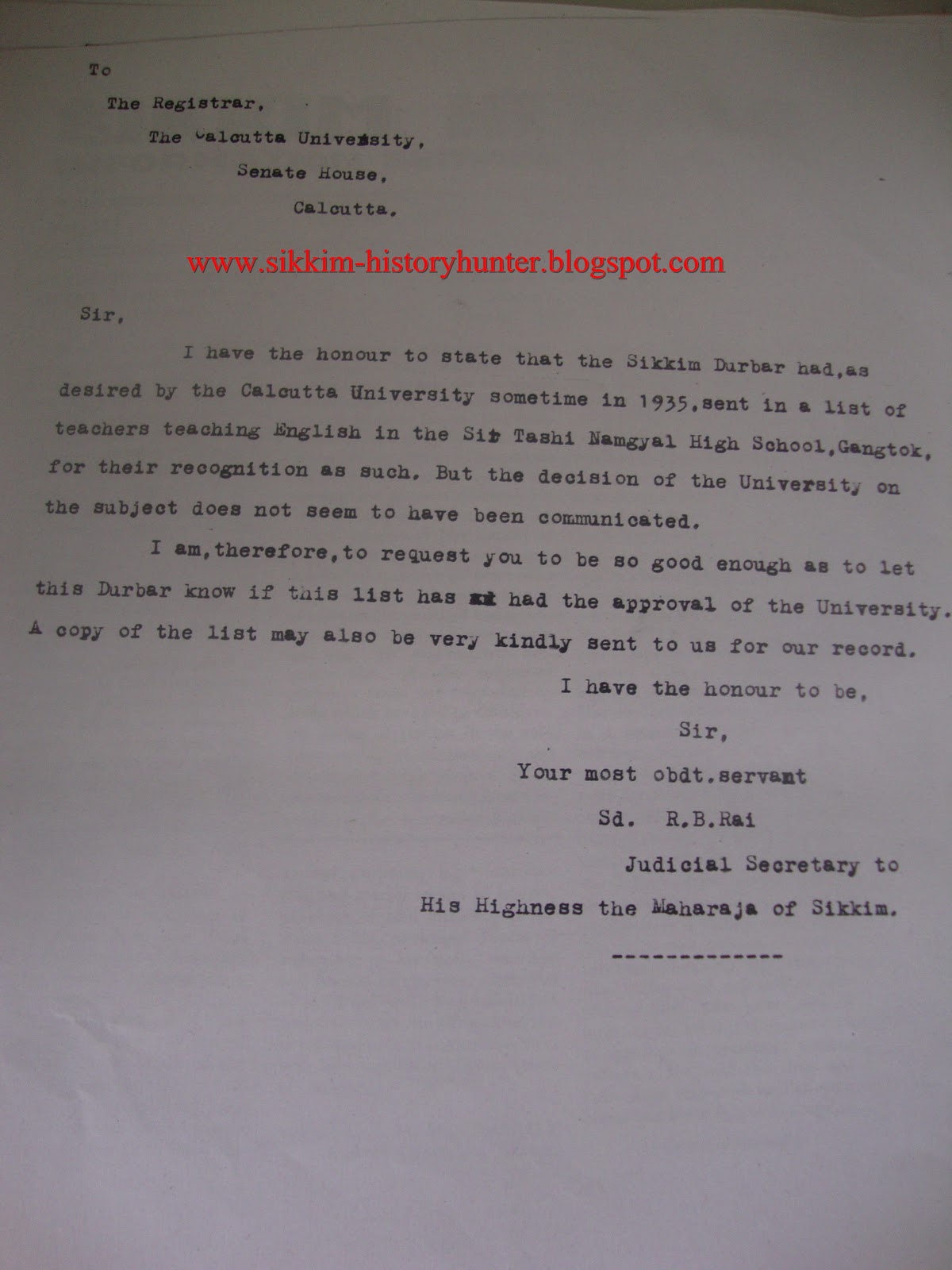
Letter of Sikkim Durbar to The Calcutta University (1935)

The modern system of education was adopted by the Government of Sikkim in the first decade of the last century. In my last post I have talked about the foundation of Gangtok School in 1906. The interesting fact about the then education system is that all the schools of Sikkim were affiliated to the Calcutta University. From the correspondence between the Judicial Secretary to His Highness the Maharaja of Sikkim and the Registrar Calcutta University it appears that, the appointment of the teachers in various schools of Sikkim was also watch over by the said University itself. The letter gives the impression that; a list of desired candidates was to be forwarded by the Sikkim Durbar to the University of Calcutta for the approval. As the endorsement letter of the University reached to the concerned department, the Sikkim Durbar had to assign them as the teachers in the different schools.

Mahakavi Laxmi Prasad Devkota at Gangtok.....


Lakshmi Prasad Devkota is regarded as the propounding father of romanticism in the Nepali literature. Devkota was deeply influenced by the writings of William Wordsworth, P.B. Shelley, Byron and John Keats. He is the pioneer of modernity or modernism in Nepali literature, especially in essays and poetry, and he is also regarded as 'Anshu Kavi'(spontaneous poet). He could write poems in a spontaneous manner and even while signing autographs for his fans, he used to write a poem before putting his signature. Devkota’s poetry depicts the romantic characteristics like humanism, metaphysical relationships, aesthetic values, past glories, praise of nature etc. Apart from romantic writings, he wrote some potent revolutionary poems possibly under the impact of P.B.Shelley.


The  masterpiece which renders him the loftiest position in Nepali Literature is his 'Muna-Madan'  in which he tried to depict the deplorable economic condition of Nepal in the most celebrated characters of two youths  Muna- a Nepali village girl and Madan- a Nepali peasant. The short epic can be compared to 'Romeo and Juliet' of William Shakespeare in the context of love and emotion 'Muna-Madan' is written in Jhyaurey prosody, the typical Nepali folk lore. This work of Devkota has been translated into several languages like German, French, English, Russian, Hindi, Japanese, Chinese etc. and it has gained same popularity as it gained in the Nepali literary world. 


The glorious Nepali poet had once visited the Demasong Valley. He was invited here by the APATAN Sahitya Parishad in November 1952. The Apatan Sahitya Parishad is the pioneer literary association of Sikkim founded by four eminent Sikkimese Nepali poets namely Agam Singh Tamang, Padam Singh Subba, Tulshi Bahadur Chettri and Nima Wangdi Lepcha. This Association has contributed a lot for the propagation of literary ideas among the Sikkimese society. He was felicitated at White Hall, Gangtok on November 15th 1952, where Lt. Kashi Raj Pradhan made an introductory speech about Devkota and Padam Singh Subba read the Letter of Appreciation, which was presented to him. The then Sikkim Maharaja Tashi Namgyal roared in laughter when Devkota recited an English poem in Vedic prosody. His Majesty, the Maharaja of Sikkim Sir Tashi Namgyal was splendidly hailed by Mahakavi Lakshmi Prasad Devkota in a poem which reads like the following:


Hail! Glorious ruler of this mount in state, 


Sikkim, the paradise of peaceful peaceful hills,


This lively sweet abode of angels, great,


Great in thy name. Thy well known bounty fills


With plenty of thy kingdom. Stainless soul,


Deeply devoted to the God that thrills


Thy inmost depth, thou findest him all whole


Thy own angelic subjects in their wills


Amassed forever in love to their great good


Selflessly hast thou lived, the Buddha life


In thy keen veins where human love must brood 


And multiply, rich and intense to thrive


Thy teeming millions to whom a holy shire


Thou dost with sense of human sacrifice aye in spire.


(The tall man in a coat in the middle of the row is Lt. Rashmi Prasad Alley, to his right Mahakavi Lakshmi Prasad Devkota, Right to Devkota is Padam Singh Subba of  'Apatan' literary association of Sikkim, to the left side of Alley, is Bal Krishna Sama a legendary figure of Nepali Language. The picture was taken at the palace corridor Gangtok in November 1952)